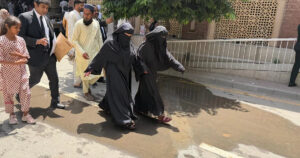
June 9 – Two and a half months after her disappearance, a Pakistani Christian woman named Neha Faqir enters the Lahore High Court wearing Islamic garb.
When bonded laborers Faqir Masih and Rasoola Bibi enrolled their 18-year-old daughter Neha in a sewing course, they believed they were giving her an opportunity for a better life. But their dreams for their daughter soon turned into a nightmare when Neha was abducted from the sewing center and forcibly converted to Islam. Now a court has rejected their petition to have Neha returned home.
Neha Faqir, the third of four children born to the Christian couple from Punjab province, had been attending a sewing center run by a local Muslim family for two months. Her parents, who live and work in a brick kiln settlement, had enrolled her there to learn a skill and gain some economic independence.
But on March 24, Neha failed to return home. When the family made inquiries, they were told she had not attended the center that day.
Intimidation and pressure
On April 1, a formal police report was registered about Neha’s disappearance. The complaint names the owners of the sewing center – an Islamic cleric named Muhammad Sajid and his two wives.
The Faqir family reported that following the filing of the complaint they faced intimidation and pressure to withdraw it. They also accused the police of not treating the matter of Neha’s disappearance with any urgency.
On learning of the case, Christian Solidarity International (CSI) engaged a lawyer to work on the family’s behalf.
To facilitate the search for Neha, the lawyer filed a habeas corpus petition with the Lahore High Court. On May 6, the court ordered the District Police Officer (DPO) of Kasur, a city to the south of Lahore, to locate Neha and submit a progress report to the court.
Neha located in Lahore
The DPO of Kasur later reported that Neha had been located at a state-run shelter in Lahore. Since this facility is located within the administrative jurisdiction of Lahore, the case fell outside the territorial jurisdiction of the Kasur police. This significantly delayed efforts to return her.
The investigation found that Neha was initially placed in a madrassa, or religious school. It is believed that this was an attempt to conceal the actual circumstances of her disappearance and mislead law enforcement.
To resolve the jurisdictional issue, the lawyer filed a new habeas corpus petition with the Lahore High Court on behalf of Faqir Masih, Neha’s father.
In response, the court issued a direct order to police to retrieve Neha from the shelter and bring her before the Lahore High Court on June 9.
Neha arrives at court in Islamic garb
On the day of the hearing, Neha’s family caught their first glimpse of her in over two months. But the girl they glimpsed was not the Neha they knew. Dressed head to foot in black robes, the 18-year-old was accompanied by a similarly dressed Muslim woman and several religious representatives.
According to the family, Neha’s mother and sister repeatedly tried to speak with her, but were not allowed to. Neither did the judge permit a conversation between Neha and her relatives inside the courthouse.
But the greatest disappointment was the judge’s ruling to dismiss the family’s petition for Neha to be returned. The family feel that all their efforts so far have been in vain.
Possible next steps
With the dismissal of the petition, they and their lawyer are weighing their next steps. Although there is the possibility of bringing the case before the Double Bench of the Lahore High Court, the prospects of success are uncertain.
At the same time, further proceedings would entail significant additional costs that would be difficult for the family to bear.
The family may decide to file an appeal. They continue to hope for an independent and fair reassessment of the case.
Pattern of abduction
Neha’s case fits a systematic pattern of abduction targeting women and girls from religious minority communities in Muslim-majority Pakistan.
For decades, Christian and Hindu girls in Punjab and Sindh have been abducted, forcibly converted to Islam, and married to Muslim men with the complicity of religious authorities. These abductions are almost never punished.
In April 2024, UN experts expressed serious concern about continued and widespread patterns of abduction and forced religious conversion through marriage affecting women and girls belonging to minority communities in Pakistan.
Nearly 1,000 girls from religious minorities are abducted each year in Pakistan, noted a 2021 BBC report, citing local human rights groups. It added that many of them are forced to convert to Islam. It also quoted the National Council of Churches in Pakistan as saying that the number of such abductions was increasing.
The sewing center setting in Neha’s case is also consistent with documented patterns. Christian girls from economically vulnerable families are often targeted through deception or intimidation, and workplaces or training centers accessible to young women have been identified in earlier cases as points of contact with perpetrators.