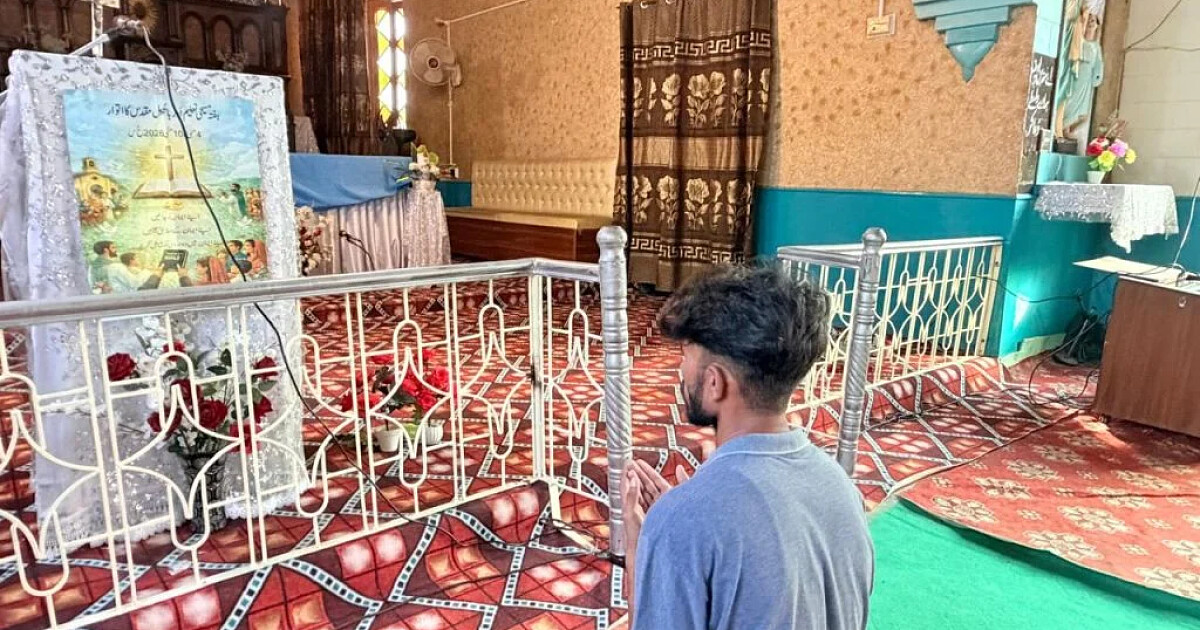
Sabir (pseudonym) Masih, a member of Pakistan’s Christian minority, kneels at church after being rescued from two years of forced conversion to Islam. CSI
When 24-year-old Pakistani Christian Sabir* Masih ran away from home two years ago, his goal was to lift his family out of poverty.
Sabir’s mother and father did have the means to provide an education for he and his brother. Instead, they went to work from a young age at a local brick kiln.
Pakistan’s Christian minority is just over three million people in a country of more than 250 million. Many of them are engaged in low-paid and often exploitative labor.
Sabir thought he had found a path to a better future when, in March 2024, he was approached by three Muslim co-workers – Ashraf, Ali and Shafiq – who offered him employment opportunities outside his village.
Disobeying his protective parents, who deeply feared these associations, Sabir left home in secret on March 25, 2024.
Sabir was completely unaware that he was stepping directly into a calculated trap.
Forced conversion to Islam
Instead of being taken to a place of employment, the young man was brought to a madrassa (Muslim religious school) in Sahiwal, a city in the province of Punjab.
Then, according to Sabir’s testimony, he was subjected to significant pressure to convert to Islam.
He reports that for days he was threatened with serious consequences, including the possibility of being implicated in a blasphemy case, if he refused to convert.
In Pakistan, the crime of blasphemy can carry the death penalty.
Alone and under threat, Sabir converted to Islam under duress on March 29, 2024.
In the months that followed, the young man was kept isolated from his family and was compelled to participate in Islamic religious practices.
But that was not all – Sabir was also exploited for cheap labor.
Instead of the better job his colleagues had promised, Sabir was brought to a box-making factory in the regional capital Lahore, where he worked under the supervision of a man named Saleem.
Instead of getting ahead, the company attributed debts to him, putting him in a position of indentured servitude.
In addition, his workplace cut Sabir’s access to communication and his contact with his family.
For more than two years, Sabir’s family had no reliable information about what had happened to their son.
Miracle in Lahore
In early 2026, a miracle happened.
A village acquaintance, Gulfam, spotted Sabir in Lahore – a city of more than 12 million people.
Gulfam informed the family, and thus began the complex process of extricating the trafficked young man.
To free their son, the family contacted Christian Solidarity International (CSI), which initiated efforts to locate and assist him.
Following an investigation and negotiations with the individuals involved, including resolving the financial claims against him, CSI secured Sabir’s release on May 19.
The reunion between Sabir and his mother, Sobia, was a scene of heartbreak and overwhelming joy.
Thirty months of suppressed agony erupted into uncontrollable tears as Sobia held the son she feared she had lost forever.
Yet, this liberation was also bittersweet, weighted down by a profound, permanent grief.
Sabir’s father, Sadaqat, had passed away on April 28, just weeks prior. His heart was literally broken by the agonizing separation from his eldest son.
Sabir was denied the chance to hold his father’s hand in his final moments, comfort his weeping mother, or stand at the grave during the funeral.
To begin to heal these deep psychological and spiritual wounds, Sabir was then brought to a church in his region.
There, before the altar, a local priest helped him renew his baptismal vows, allowing Sabir to formally reclaim his identity, weep for his departed father, and finally begin the long, painful journey of rebuilding his shattered life.
*Sabir is a pseudonym used for security reasons, due to the sensitivity of his case.