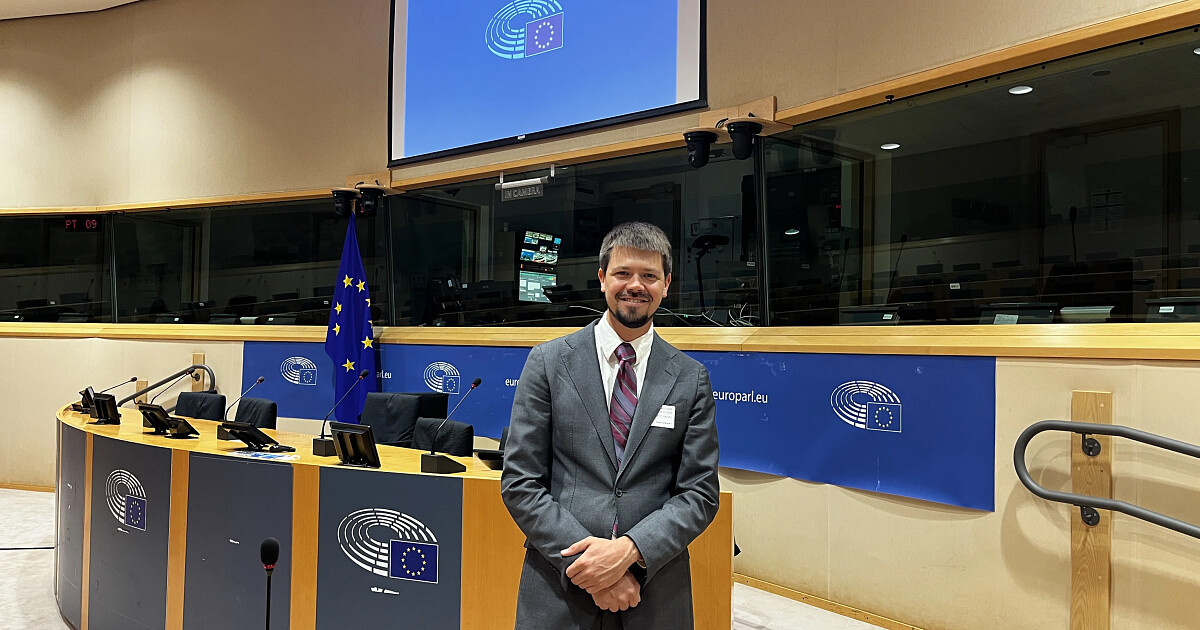
Dr. Joel Veldkamp, Christian Solidarity International’s Director for Public Advocacy, delivered the following statement at the European Parliament in Brussels on July 14, 2026, at an event hosted by MEP Costas Mevrides and MEP Miriam Lexmann.
We are here today to discuss the twenty Armenian men who are currently being held hostage by the government of Azerbaijan. Each one of these cases is a human life, a person with a family who waits for his return. Each case is a human rights emergency in its own right.
But more than these 20 lives is at stake in this discussion. The imprisonment of these men must be understood as part of the larger project by the Azerbaijani state to destroy the Armenian community of Nagorno Karabakh, also called Artsakh.
The question of Nagorno Karabakh is in turn tied to the question of what kind of international order will emerge from the period we are living in now – a period of protracted interstate warfare of the kind of that international relations experts used to regard as a thing of the past.
I’d like to begin today with a quote from one of the hostages we are here to speak about – Mr. David Babayan, the former foreign minister of the Republic of Artsakh.
It is the last public statement we have from Mr. Babayan, and it was made on his Facebook page on September 28, 2023.
We need some context here. This was 9 days after the armed forces of Azerbaijan launched an invasion of Nagorno Karabakh.
For nine months leading up to that invasion, Azerbaijan blockaded the Lachin Corridor – the only road connecting Nagorno Karabakh to the Republic of Armenia, and from there to the outside world. The 120,000 Armenian Christians living in Nagorno Karabakh were trapped. Supplies of food, medicine, and fuel dwindled to dangerous levels, and the population began to suffer from hunger and preventable illnesses. The miscarriage rate among pregnant women tripled.
On September 19, Azerbaijan launched an attack on the entire territory of Artsakh. The attack quickly overwhelmed the local self-defense forces. It also knocked out nearly all the communications networks in the area. The majority of the Armenian population was forced to flee their homes to escape the shelling – although, with the Lachin corridor closed, there was nowhere for them to escape to.
For five days, the Armenians of Nagorno Karabakh sheltered in place – unable to return to their homes to search for their relatives, unable to call their friends to check on them, unable to evacuate the wounded to the few hospitals that still functioned after nine months of blockade. Armenians who did venture out risked getting shot or detained by Azerbaijani troops.
Then, on September 24, it was announced that Azerbaijan was going to re-open the Lachin Corridor. Anyone who wanted to leave Nagorno Karabakh would be allowed to pass through the Azerbaijani checkpoint and find refuge in Armenia. But it was not known how long the Corridor would stay open. And no one knew for sure who the Azerbaijanis would allow to pass.
Nevertheless, the terror that Azerbaijan had engineered among the Armenian population over the nine months of the blockade was so great that virtually the entire population crammed themselves into whatever vehicles were available and still had enough fuel to operate, and drove down the Lachin Corridor towards Armenia. Because of the congestion, a journey that normally takes two hours took many families two days, or even longer.
As this exodus was underway, David Babayan made his final public statement. On September 28, he wrote on his Facebook page, quote,
“Dear compatriots, friends, party members!
You all know that I am included in the black list of Azerbaijan and the Azerbaijani side demanded my arrival in Baku for an appropriate investigation. I decided to head from Stepanakert to Shoushi today. [Shoushi is a city that is under Azerbaijani control. He was announcing that he would turn himself in.]
Quote: “This decision will naturally cause great pain, anxiety and stress, primarily to my loved ones, but I am sure they will understand.
My failure to appear, or worse, my escape, will cause serious harm to our long-suffering nation, to many people, and I, as an honest person, hard worker, patriot and Christian, cannot allow this.
God bless our people, may the Almighty reduce their suffering and heal their wounds.”
I cite this statement from Mr. Babayan today for two reasons. One is to show that the 20 Armenians held hostage in Baku today are not merely victims of a violent authoritarian state. They are that, but many of them have also behaved heroically and with great dignity, both in the events that led up to their abduction, and during their imprisonment ever since.
But the second reason is that this message shows that David Babayan understood that, in a very real sense, in 2023, the entire Armenian population of Nagorno Karabakh was being held hostage. Mr. Babayan knew that if he did not cooperate with the Azerbaijanis, then they were ready to inflict even more punishment on the entire population. It was clear to everyone that ethnic cleansing was going to happen. There was no question of the Armenians being allowed to remain in their homeland. The only question was whether the Azerbaijanis would allow them to leave safely, or if there would be a general massacre or other atrocities.
This threat was made quite explicitly by Elchin Amirbayov, a representative of the President of the Republic of Azerbaijan, in an interview with Deutsche Welle on September 7, just twelve days before Azerbaijan’s invasion. Asked by the reporter if his country was carrying out a genocide in Nagorno Karabakh, Amirbayov replied, “A genocide may happen only if this clique of separatists continue to hold hostage their own population in order to get to their political goals.”
By “this clique of separatists,” Mr. Amirbayov was referring to the elected government of the Republic of Artsakh, eight current and former members of which today sit in jail cells in Baku.
If these men did not comply with Azerbaijan’s wishes, Mr. Amirbayov said, quote, “a genocide may happen.”
In the event, on September 28, the president of the Republic of Artsakh, Samvel Shahramanyan, announced that he would comply with Azerbaijan’s demands and dissolve the Republic, in exchange for Azerbaijan guaranteeing “free, voluntary and unhindered travel” for the Armenians.
By any measure, in Nagorno Karabakh, Azerbaijan carried out one of the most complete, most successful ethnic cleansing campaigns in modern history. In the space of seven days in September 2023, the population of Nagorno Karabakh went from nearly 120,000 Armenians to less than fifty. Today there are likely zero.
This conflict did not begin in 2023. It began during an earlier wave of ethnic cleansing.
In 1991, Armenians in Nagorno Karabakh were facing blockade, regular bombardment and deportations by Azerbaijani and Soviet troops. They responded by exercising their right to self-determination. They seceded from the Soviet Union, just as Armenia and Azerbaijan did the same year, and created their own republic, officially named the Republic of Artsakh. While the Republic of Artsakh remained unrecognized, for thirty years, it was a reality on the ground.
Through the Organization for Security and Cooperation in Europe, the international community created a mechanism called the Minsk Group to resolve the Nagorno Karabakh conflict. The Minsk Group was co-chaired by France, Russia, and the United States. This peace process took many turns, but through it all, the right of the people of Nagorno Karabakh to self-determination was accepted by all parties as an essential part of any final peace settlement in the region.
It is for this reason that, between 1997 and 2020, the Co-Chairs of the Minsk Group regularly traveled to Stepanakert, the capital of Artsakh, to conduct official meetings with the political leadership of the Republic of Artsakh. Other representatives of the Minsk Group engaged with the leaders of Artsakh from 1992 all the way until 2023. Throughout the entire lifespan of the conflict, international institutions consistently approached Artsakh officials as legitimate dialogue partners, and rightly so. Today, many of these officials are being illegally held in Baku’s prisons. These include former Presidents Arkadi Ghukasyan, Bako Sahakyan, and Arayik Harutyunyan, as well as former Foreign Minister David Babayan.
In Baku, these men have been accused of a range of preposterous charges, from genocide to financing terrorism to slavery. They have been subjected to show trials which fall absurdly short of minimal international standards of fairness. Their lawyers have not even been given copies of the final verdicts against them, much less the purported evidence of their guilt.
But the true crime of these men is to have represented their people, to have been chosen to serve in a government established through an act of self-determination by the Armenians of Nagorno Karabakh. By putting them in prison, Azerbaijan is finalizing its goal of destroying the existence of the Armenians of Nagorno Karabakh as a people.
One month after the ethnic cleansing of Nagorno Karabakh, President Ilham Aliyev of Azerbaijan boasted, “Many reiterated there is no military solution to this conflict. We have shown that there is. This topic is now closed! The subject of the Karabakh conflict is closed once and for all!”
And this brings us to the crux of things, politically speaking. By not intervening on behalf of these twenty men, by not insisting that they be released, the international community is accepting what Azerbaijan has done. They are accepting that military force can be used to resolve conflicts, to nullify the right of peoples to self-determination, and to accomplish ethnic cleansing.
If that were all, securing the release of these hostages would already be a matter of urgency for Europe and the European Union. But by staying silent about these hostages, Europe is in fact accepting something else. They are accepting Turkish hegemony over a strategically vital region.
In recent months, there has been much celebration of Europe’s warming relations with the Republic of Armenia. In May, a joint EU-Armenia summit, and a summit of the European Political Community were both held in Yerevan, a rather ostentatious sign of deepening ties.
But Europe has also been strengthening its relations with Azerbaijan, which is poised to become a key energy supplier and security partner. The European Commission has shown total disregard for Azerbaijan’s atrocious human rights record, including the ethnic cleansing of Nagorno Karabakh. And Europe’s warming ties with Armenia are based on Armenia’s acceptance of a peace process with Azerbaijan shepherded by the European Union and the United States. This peace process has required Armenia to make enormous concessions to Azerbaijan, while almost nothing has been demanded of Azerbaijan in return. All this, while Azerbaijan’s leaders refuse to a final peace treaty, and regularly refer to the entire Republic of Armenia as “Western Azerbaijan,” and insist that its citizens must settle there.
Let us be frank: Europe’s policy in this region is creating a weak Armenia. And a weak Armenia will be of very limited value to Europe.
Europe’s policy is also empowering Turkey. The Republic of Turkey is Azerbaijan’s closet military and strategic ally, a state with which it shares a language and a common history. Azerbaijan’s military has worked hand-in-glove with Turkey’s military in its campaigns against the Armenians since 2020. Turkish and Azerbaijani leaders both use the slogan “Two states, one nation” to describe this alliance.
The NATO summit in Ankara last week highlighted how Turkey is moving to the center of decision-making on a whole range of economic and security issues affecting Europe. Given Turkey’s severe democratic deficits, and its high-handed treatment of Europe on everything from migration to Ukraine, Turkey’s rise poses serious challenges to Europe, to say the least.
The end process of Europe’s current policy is that Armenia will be required to integrate itself into Turkey’s regional security architecture in order to maintain a semblance of sovereignty over its own territory. This Armenia will have no ability whatsoever to act as a counterweight against Turkish interests in this key section of the Middle Corridor. Europe seems to think that it is gaining access to valuable new trade routes and energy supplies in the Caucasus. In fact, it is handing them over Turkey.
A strong Armenia could be a useful ally to the European Union, as Europe seeks to navigate an era of growing Turkish influence and weak international norms. In order to empower Armenia, European policymakers would be prudent to look for ways to make the Armenia-Azerbaijan peace process less lopsided.
Intervening for the twenty Armenian hostages in Baku would be an excellent place to start.