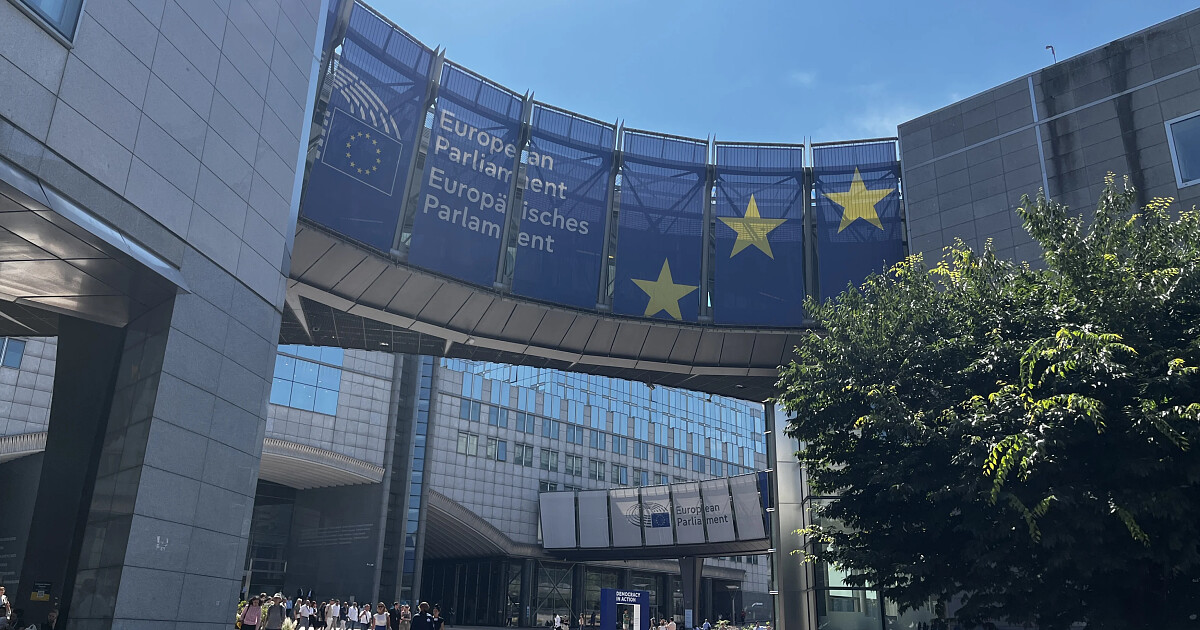
BRUSSELS — More than 1,000 days after the ethnic cleansing of Nagorno Karabakh, twenty Armenian Christians are still being held hostage by the government of Azerbaijan. Today, that fact was placed before the European Parliament at a panel discussion entitled “Armenian Political Prisoners in Azerbaijan and the Imperative of EU Engagement,” co-hosted by MEP Costas Mavrides (S&D, Cyprus) and MEP Miriam Lexmann (EPP, Slovakia), and facilitated by the European Armenian Federation for Justice and Democracy (EAFJD).
Watch the event here.
Joel Veldkamp, Director for Public Advocacy at Christian Solidarity International (CSI), warned that the European Union’s approach to the Armenia-Azerbaijan peace process is producing a weakened Armenia and strengthening Turkey’s position across a strategically vital region.
“Let us be frank: Europe’s policy in this region is creating a weak Armenia. And a weak Armenia will be of very limited value to Europe,” he said.
In September 2023, Azerbaijan invaded and ethnically cleansed Nagorno Karabakh (or Artsakh), a land that has been inhabited by Armenians for thousands of years. The entire Armenian Christian population of 120,000 was forced to flee, and a number of Armenians, especially current and former members of Artsakh’s government, were abducted by Azerbaijan.
Threats of genocide against Artsakh Armenians
Veldkamp argued that the prolonged detention of Armenian leaders from Artsakh must be understood not as an isolated legal matter, but as the final stage of Azerbaijan’s campaign to erase the Armenian community of Nagorno Karabakh.
Veldkamp cited the final public statement of David Babayan, made as he turned himself over to Azerbaijani forces in September 2023, as evidence that Artsakh’s leaders understood that the faced a simple choice: comply, or risk mass atrocity against the population they represented.
He pointed to a September 2023 interview in which an adviser to Azerbaijani President Ilham Aliyev warned that “a genocide may happen” if Artsakh’s government did not capitulate — a threat made public just twelve days before Baku’s invasion of the territory.
Within a week of that invasion, Nagorno Karabakh was emptied — what Veldkamp described as one of the most complete ethnic cleansing campaigns in modern history.
Europe’s strategic blunder
Veldkamp noted that for decades, international mediators recognized Artsakh’s elected leadership as legitimate dialogue partners. From 1997 to 2020, he said, co-chairs of the OSCE Minsk Group regularly traveled to Stepanakert to meet with officials in Artsakh’s government — the same officials Azerbaijan now subjects to what a March 2025 European Parliament resolution deemed “sham trials”.
Turning to the EU’s current posture, Veldkamp argued that Europe’s warming ties with both Armenia and Azerbaijan mask a lopsided reality: an EU- and US-brokered peace process that has demanded major concessions from Armenia while asking almost nothing of Azerbaijan, while Azerbaijani leaders increasingly refer to the Republic of Armenia as “Western Azerbaijan.”
Because Azerbaijan operates in close military and strategic partnership with Turkey — the two nations describe their alliance as “two states, one nation” — Veldkamp warned that a weakened Armenia would have no capacity to serve as a counterweight to Turkish influence over the emerging “Middle Corridor” trade route.
“Europe seems to think it is gaining access to valuable new trade routes and energy supplies in the Caucasus,” Veldkamp said. “In fact, it is handing them over to Turkey.”
Veldkamp called on European policymakers to correct this, starting with a concrete demand: the immediate release of the twenty Armenian hostages, now entering their fourth year of captivity.
Criminalizing the Armenians’ right to self-determination
The legal dimension of the hostages’ cases was addressed by panelist Siranush Sahakyan, a lawyer representing the Armenian prisoners, who said she has still not been granted access to her clients. Sahakyan described the twenty men — including eight former military and political leaders of Artsakh — as instruments of “hostage diplomacy.”
“In order to justify their continued detention, they have come up with bogus charges,” Sahakyan told the conference, arguing that Azerbaijan’s prosecutions are designed to rewrite the history of Artsakh, criminalize its institutions, and portray the very institution of Armenian self-government as criminal.
She rejected the premise that Artsakh’s unrecognized status could justify the charges against its former leaders. “Lack of recognition is not the same as criminal activity,” Sahakyan said, noting that unlike cases such as Southern Rhodesia or Northern Cyprus, the United Nations Security Council never declared Artsakh’s independence null and void, nor called on other countries not to recognize it, but rather accepted its status as up for negotiation and its leaders as parties to those negotiations.
“My father did not go with us”
The human toll behind the legal and political arguments was brought into the room by Armen Ishkhanyan, son of captive Artsakh parliament president, David Ishkhanyan. He told the conference that his family was forced to relocate to Armenia following Azerbaijan’s 2023 aggression, but that his father stayed behind.
“My father did not go with us,” Ishkhanyan said. “As a public official he felt a duty to remain behind and ensure the safe evacuation of the civilian population. Only then would he leave.”
On October 3, 2023, Ishkhanyan said, his family learned that Azerbaijani security forces had arrested the political and military leadership of Artsakh, including his father. “Since then, my family has been through a psychological ordeal that is impossible to describe,” he said.
“Several days ago, it was my daughter’s birthday,” he said. When I asked her what she wanted, she did not want any present. She simply said, “I want my grandfather to come home.”
When the panel opened to questions from the audience, European Commission President Ursula von der Leyen’s recent praise of Azerbaijani President Ilham Aliyev was raised.
Co-host MEP Mavrides did not spare words, telling the audience, “I cannot accept this hypocrisy anymore.”
Drawing on his own history as a refugee driven from his home by the Turkish invasion of Cyprus, he turned the moment personal.
“I was once a victim of aggression by the Turkish invasion and I’m a refugee,” he said. “So personally, you have the commitment of my party and political group — you will never be alone.”

About CSI
Christian Solidarity International (CSI) is an interconfessional Christian human rights group, campaigning for religious liberty and human dignity, and assisting victims of religious persecution, victimized children, and victims of catastrophe.
CSI is an NGO with consultative status at the United Nations Economic and Social Council.
Christian Solidarity International was founded in Switzerland in 1977 by Rev. Hans Stückelberger and is active in more than 20 countries with public advocacy initiatives and humanitarian aid projects.
Contact: Patrick Degenhardt | [email protected]
Media contact: Dr. Joel Veldkamp | [email protected]