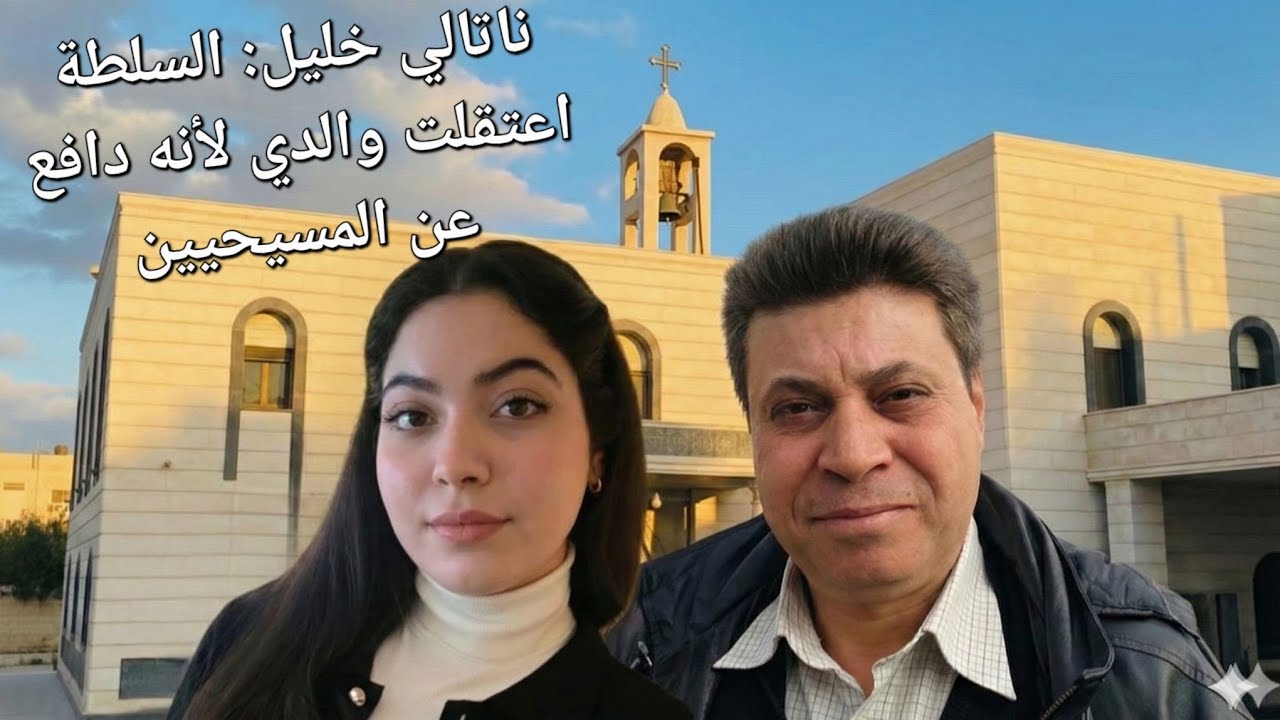
Natalie Khalil speaks out about the imprisonment of her father Suleiman Khalil (pictured) in Syria. sami alkayial on youtube
In an interview conducted in Arabic by Syrian author Sami Alkayial, Natalie Khalil, 21, spoke for the first time to a Syrian audience about her father Suleiman’s detention by Syria’s new rulers and what it reveals about the precarious situation facing the country’s minorities.
Suleiman Khalil, 51, served from 2012 until 2016 as mayor of Sadad, a historic Syriac Christian town in rural Homs mentioned twice in the Bible (Numbers 34:8 and Ezekiel 47:15). He was arrested at his home in Sadad on February 8.
Defending Sadad against Jabhat al-Nusra and ISIS
Syria’s long civil war, which began in 2011, pitted the brutal dictatorship of Bashar al-Assad against a rebel coalition dominated by jihadist groups – groups that attacked Christians and other religious minorities in Syria.
In December 2024, Assad was finally overthrown by a jihadist force led by Ahmed al-Sharaa, the founder of Jabhat al-Nusra, al Qaeda’s affiliate in Syria. Al-Sharaa, known during the war as Abu Muhammad al-Jolani, declared himself president of Syria in January 2025.
In October 2013, Jabhat al-Nusra, whose leadership now forms Syria’s current ruling authority, attacked Sadad while Suleiman was mayor. The jihadists killed forty-one Christian civilians before they were forced to retreat.
In 2015, Sadad was attacked again – this time by ISIS.
According to Natalie Khalil, the Syrian army fled during the fighting, leaving her father to organize the town’s defense.
“He never carried a weapon,” she emphasized. “His role was organizational and political.”
During the 2015 attack, Suleiman’s men successfully defended Sadad. ISIS was prevented from entering the town – likely averting a massacre of the Christian population. For his role in saving the town, Suleiman became a local hero.
Despite serving as mayor under the Assad regime, Khalil was no regime loyalist. He was a member of a party historically opposed to Assad’s Ba’ath party, and was elected mayor in 2012, at a time when the regime’s control was weakened. As mayor, he publicly confronted the Syrian army over soldiers harassing local women, and defeated a lawsuit filed against him in retaliation. The Assad regime dismissed him in 2016.
When the Assad regime finally collapsed, Suleiman Khalil gathered his family in celebration. “He told us we had witnessed something people died dreaming of,” his daughter recounted.
Arrest without charges
Yet Khalil was detained three months after the new authorities took power. Security forces arrested him at his home – bearing a warrant, but not stating any specific charge. For three months after his arrest, when his family sought to visit him in prison, officials told them that his name wasn’t in their records. He had effectively been disappeared.
“Same practices as the old regime,” Natalie Khalil observed.
After three months, his family was able to locate him in Homs Central Prison. He is still being held there, without legal representation or formal proceedings. His daughter believes the arrest stems from malicious reports tied to his Christian faith and possibly retribution for defending Sadad against the forces now in power.
Send a message to Syria's foreign minister calling for Suleiman's release
Prison conditions and religious coercion
The prison, Natalie reported, is administered by religious sheikhs and shari’a officials who impose Islamic law on all detainees. When she and her mother visited through unofficial channels, they were required to put on the hijab, a head covering worn by conservative Muslim women. Natalie’s modest clothing was deemed inappropriate. On a later visit, her mother was provided an abaya (a full body covering for women) at the entrance.
During these short visits, Natalie learned that her father had been forced to fast during Ramadan, and given the Qur’an to read. He was being held in unsanitary conditions, and given inadequate food and expired medication.
“A respectable man”
The interview sparked significant engagement among the Syrian community, with commenters offering their solidarity.
One noted that Khalil “was perhaps the only mayor who took down the Ba’ath Party flag on his very first day” in office. Another wrote: “Any free and honorable Syrian supports the release of Mr. Suleiman Khalil, because he is a respectable man.”
Most pointedly, one viewer suggested the arrest represents “a vendetta with Jolani himself going back many years,” seeing it as retribution for Khalil’s resistance to al-Nusra’s 2013 attack.
A community’s exodus
In the interview, Natalie Khalil spoke to broader patterns accelerating minority emigration from Syria. Current policies, she argued, are driving out Christians and other non-Sunni communities, while Christian religious leaders “lack real influence” over the new authorities.
“The Christian voice could make a difference right now,” she said. “But they don’t want to speak, because the the people are afraid.”
In November 2025, CSI brought Natalie to Washington D.C. to advance the campaign for her father’s release. The delegation met with Congressman Pete Aguilar, the U.S. Commission on International Religious Freedom (USCIRF), and other key officials.
CSI has launched a public campaign inviting supporters to contact Syria’s foreign minister directly to demand Khalil’s freedom.
A message to Syrians
Concluding the interview, Khalil addressed Syrian viewers directly:
“When you demand the release of my father or any detainee, you’re defending the case of Syrians who are your brothers, your family, your people. We all belong to each other. Away from sectarianism, we must love and support each other to get through this phase.
“Be certain that this government will not stay here forever. You will remain.”
For a deeper dive into Suleiman’s story, listen to Episode 5 of The Christian Solidarity Podcast: Why is Suleiman Khalil in prison in Syria?
Watch the interview with Sami Alkayial in Arabic