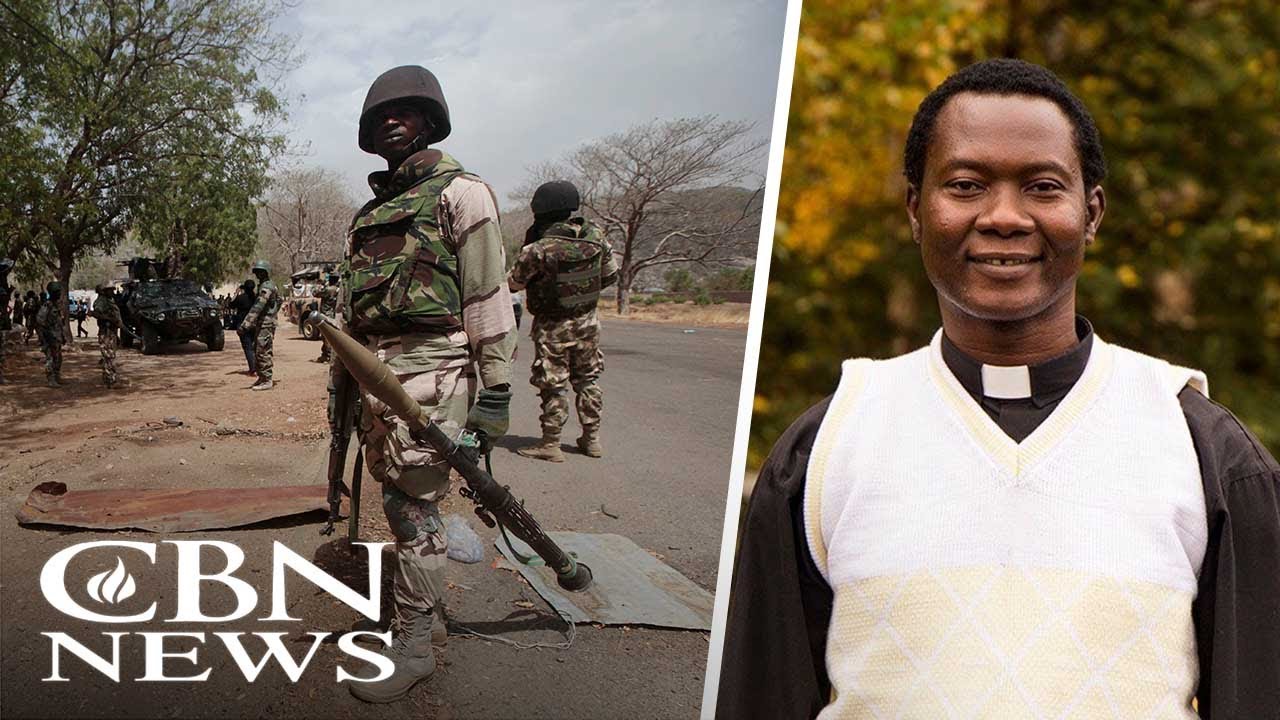

Father Daniel Alphonsus Afina partnered with CSI to distribute aid to Christians attacked by Boko Haram, until he himself was abducted in June. acn
Father Daniel Alphonsus Afina serves in Maiduguri, the city that Veldkamp describes as “ground zero for the Boko Haram terrorist movement that’s been terrorizing Christians for almost 15 years now in Nigeria.” As one of CSI’s partners, the priest helps distribute food to people who have survived Boko Haram attacks and are now displaced, living in camps in the capital city of Nigeria’s Borno State.
The attack and abduction
The abduction occurred while Father Afina and his team were traveling from one town to another in the region. Their convoy was attacked with rocket-propelled grenades (RPGs). The assault killed Zion Japhet, another CSI partner, while Father Afina was taken captive.
“His abductors forced him to call his bishop, tell him that he had been abducted. He got to ask the bishop to pray for him. And that’s the last contact that we’ve had with him,” Veldkamp explained during the interview.
When asked about Father Afina’s current condition, Veldkamp confirmed they have heard nothing since that initial phone call.
Father Afina’s case represents part of a disturbing trend of terrorists targeting Nigeria’s Christian leadership. Veldkamp noted that this year alone, at least 15 priests and pastors have been kidnapped in Nigeria so far.
The motivations behind these kidnappings vary significantly. “Sometimes they want ransom money, and other times they abduct them in order to kill them and terrorize the Christian community,” Veldkamp explained. In Father Afina’s case, “the fact that we have heard so little is frankly worrying.”
Nigeria’s religious demographics and violence
Although Nigeria’s population of 200 million is nearly evenly split between Christians and Muslims, the country has become one of the most dangerous places in the world for Christians. “More Christians are killed for their faith in Nigeria than any other country in the world by far,” stressed Veldkamp.
The geographic distribution of violence follows distinct patterns. Most Christians live in the south, although many Muslims live there as well. The north of Nigeria is mostly Muslim. The violence against Christians is most intense in the north, where extremist groups have operated since 2009.
“Beginning in 2009, extremist groups like Boko Haram, which later aligned with ISIS, started a campaign to wipe out Christianity in northern Nigeria,” Veldkamp explained. “That was their goal: all Christians should convert, be killed, or leave.”
The Middle Belt region, historically mixed between Muslims and Christians, has become another flashpoint. Here, “groups drawn from the Fulani ethnic group are attacking Christian village after Christian village, just massacring the people and driving the survivors away.” As a result, Veldkamp describes the current situation as “a kind of a slow ethnic cleansing process. They’re trying to turn a religiously mixed region into a region that’s all Muslim.”
Government connections and complicity
Veldkamp points to troubling connections between Nigeria’s government and the terrorist groups. “This really has to do with efforts by the security elite in Nigeria to maintain control over the country and to preserve their power and privilege,” he explained. “They are using these groups as instruments of their authority.”
Veldkamp believes these connections could be leveraged to help secure Father Afina’s release. “Frankly we believe that there are figures in the Nigerian security establishment who have links to Boko Haram and who have links to other Islamic terrorist groups operating in Nigeria and they should use those links to get this man home to his church to his loved ones,” Veldkamp said.
Father Afina’s background and sacrifice
Father Afina’s intentional commitment to serving in Nigeria adds particular poignancy to his disappearance. Until 2024, he had been living in Alaska for seven years, working with different dioceses in the United States. During his time there, “he was taking special courses in counseling and therapy with the intention of helping Nigerians who have been traumatized by these attacks.”
His decision to return to Nigeria was deliberate and sacrificial. “He made the choice to return to Nigeria to serve his people,” Veldkamp explained. “So this is someone who went back into the fire to help his fellow Christians, to help his fellow Nigerians. And this is really an example of faith and service for all of us.”
Impact on CSI humanitarian work
The targeting of CSI partners like Father Afina creates a risk of future operational challenges. Because Father Afina was part of the Justice Development and Peace Commission run by the Catholic Church in Maiduguri, his colleagues have stepped in to continue the work. “So thankfully our operations in Maiduguri are continuing relatively unhindered,” Veldkamp noted.
However, the broader impact is huge. “This is a huge deterrent to other people who might want to join relief efforts because it is dangerous work,” Veldkamp acknowledged. “I’m convinced that he was kidnapped because Boko Haram does want to terrorize people and to keep people from trying to help their fellow Nigerians who are suffering in this situation.”
Calls for government action
CSI has outlined specific actions they want to see from the Nigerian government. “Certainly, the case needs to be taken seriously,” Veldkamp explained. “It would be great if the Nigerian president made a public statement on the matter. And it would be very welcome to see increased military and peacekeeping operations in Maiduguri.”
Beyond these immediate steps, CSI believes the government should utilize existing connections to bring Father Afina safely home.
US policy concerns
Veldkamp highlighted the inadequacy of the American approach to Nigeria’s crisis. “Unfortunately, the United States does not seem particularly interested in addressing this issue. The United States appears to believe that as long as it maintains a good relationship with the Nigerian government, it can achieve its objectives in Nigeria regardless of how many Christians are being killed there.”
Regarding the current Trump administration’s potential approach, Veldkamp said, “The jury is still out. President Trump obviously has his hands full, as there is much happening in the world, but Nigeria is a critical country for the United States and globally.”
CSI continues to advocate for Father Afina’s release. Read CSI’s statement on Father Afina’s abduction.
Watch the interview