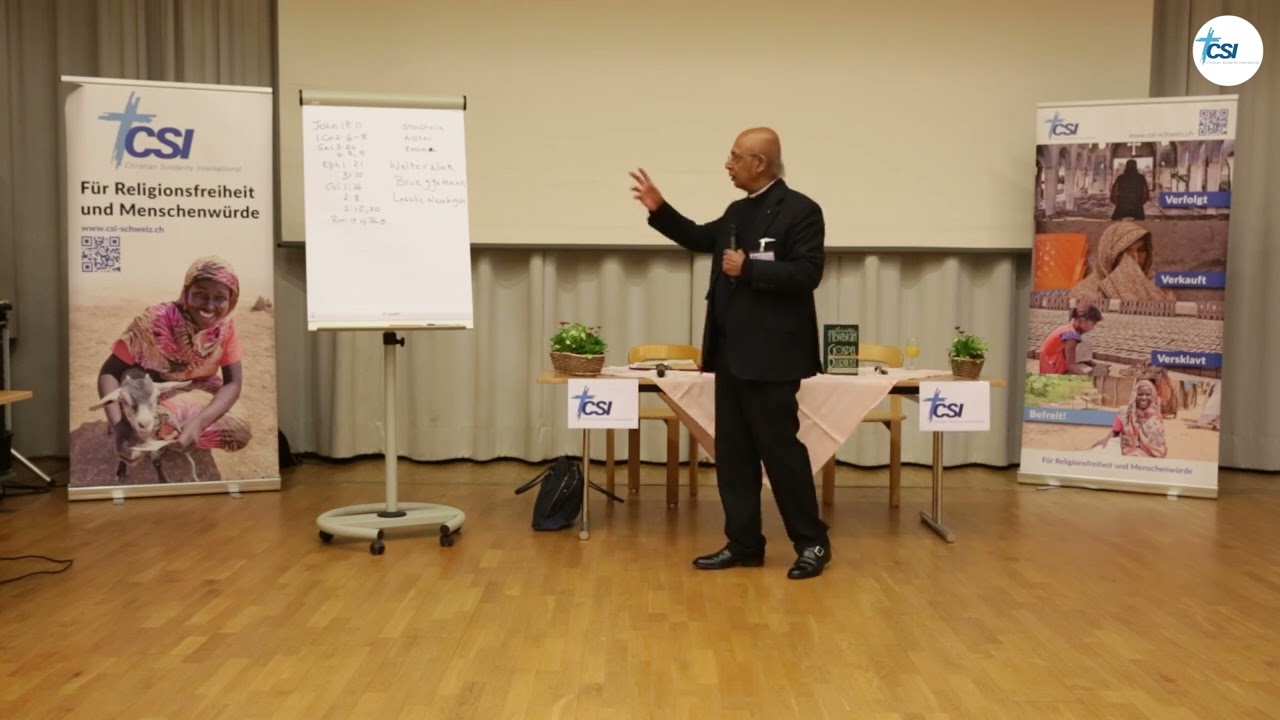
What hidden forces drive the increasing religious persecution, political instability, and ideological division in our world? This question was at the heart of Monsignor Michael Nazir-Ali’s address at an event hosted by Christian Solidarity International (CSI) in Zürich on April 1, 2025. Dr. Nazir-Ali, a prominent Christian leader who has served as Bishop of Rochester in the UK and Bishop of Raiwind in Pakistan before being received into the Catholic communion in 2021, brought a unique cross-cultural and ecumenical perspective to this question.
Understanding the invisible dimensions of persecution
“When we are dealing with persecuted Christians and indeed other persecuted communities, we often have the sense that we are not just dealing with wicked individuals who are persecuting,” Nazir-Ali observed. “There is something more than that, something extra.”
This “something extra” was the focal point of his lecture. By this “something extra,” Nazir-Ali referred to deeper forces, whether ideological, cultural, or spiritual, that seem to operate behind human conflicts and persecution. When hatred and violence reach systemic levels that transcend individual actors, he suggested, we are witnessing something more profound than merely personal wickedness.
These unseen forces shape societies, inform ideologies, and drive patterns of oppression that often follow similar patterns across different cultures and eras. In Christian understanding, these forces are sometimes referred to as “principalities and powers.” These structures and systems were originally created by God to provide for good governance and human flourishing, but have become corrupted and now often work against human dignity. Nazir-Ali sees this dynamic operating at a deeper, even spiritual level.
Drawing from St. Paul in Ephesians 6:12 – “For we wrestle not against flesh and blood, but against principalities, against powers, against the rulers of the darkness of this world, against spiritual wickedness in high places” – Nazir-Ali offered a framework for understanding the deeper dimensions of conflict and persecution that goes beyond individual actors.
Created, fallen, and redeemable
In his analysis, Nazir-Ali explained that principalities and powers are part of God’s created order. They are the basic structures of human society, including families, nations, and religious organizations. They were “created by Christ and for Christ,” he emphasized, citing Colossians 1:16. However, like all of creation, these powers have fallen.
Nazir-Ali explained that these powers represent “the informing principles of human organization… what inspires them.” He invited his audience to consider “the intelligence of the organization” or “the spirit of an organization, the spiritual aspect of a nation, of a community, of a religious organization.” This spiritual dimension, he suggested, helps explain why persecution often exceeds what could be expected from mere individual malice.
“What is the inspiration for acting in a particular way against a religious or ethnic minority?” he asked. “What is it that leads people to enslave other people? What is it that leads the [Fulani terrorists] to come further and further down Nigeria to kill the farmers and occupy their land? It’s not just individual. It’s something more than that.”
The fallenness of the powers manifests in what Nazir-Ali described as “systems of domination” driven by the desire for power, greed, and exploitation.
Yet he emphasized a message of hope: “Created, fallen, redeemed—that should be our story. That is the message of the church to the world. And it is also a message of the church to the principalities and powers.”
Global manifestations of fallen powers
Nazir-Ali provided concrete examples of how these fallen principalities operate in today’s world, illustrating their diverse yet interconnected nature. He began with common tyranny, citing Eritrea, where “one man’s obsession with power has created suffering first for evangelical Christians, then for the Orthodox and for the Catholics.”
In contrast, some persecutions are ideologically driven. Marxist regimes in China and Albania attempted to systematically stamp out Christianity through state policy. Paradoxically, though, the church has grown exponentially under this pressure. Nazir Ali noted that today, the main international airport in Albania’s capital city, Tirana, is named “Mother Teresa International Airport.” “You see, that’s the victory of Christ,” he said.
Radical Islamism is yet another ideological driver of persecution. Nazir-Ali cited as an example the blasphemy laws in Pakistan, which have victimized many, including Asia Bibi and Salman Taseer, the former governor of Punjab who was assassinated for defending her. Equally concerning is the rise of new forms of nationalism from Europe to India, where ideologies “celebrate race, ethnicity and even religion to define who is in and who is out,” leading to violence against minorities. And perhaps most subtly pervasive is secularism in the West, where Christians face growing discrimination in employment and professional life. Nazir-Ali shared examples of individuals in the UK who lost their jobs or positions due to their convictions, highlighting that while persecution takes different forms in different contexts, the underlying spiritual dynamics remain the same.
The Christian response: Truth, justice, and peace
What should Christians do in the face of those challenges? Nazir-Ali returned to Ephesians 6, urging believers to “take the whole armor of God.”
Citing St. Paul’s admonition to “gird yourself with truth,” Nazir-Ali explained that speaking truth to power takes different forms in different contexts. In Pakistan, it means challenging blasphemy laws. In Syria, it means questioning who arms and trains extremist groups. In the West, it means rejecting “a false anthropology…a false view of the human condition.”
Nazir-Ali also urged Christians to pursue justice in the face of persecution from the powers, and praised organizations that provide legal support to Christians facing discrimination. “Seeking justice for those who have been unjustly dealt with because of their faith or maybe for some other reason is very important,” he said. “This is what St. Paul means when he says, ‘Put on the breastplate of justice.’”
Yet all these efforts must serve a greater purpose: peace. “Whatever we do, whatever intermediate steps we may take, the end result must be reconciliation, the restoration of friendships, the wholeness of society, the integrity of the family, all of these things that make for peace.”
Realistic hope in dark times
During the Q&A section, CSI’s Advocacy Director Joel Veldkamp asked whether, in a darkening world, Christians could offer a worldly hope to compete with the false paradises dangled to their followers by the powers. In his response, Nazir-Ali rejected both passive waiting and utopian promises.
“What we don’t want is a kind of false apocalypticism or false eschatology,” he cautioned. “I think we have a responsibility to do what we can whilst awaiting the final vindication of Christ and by Christ.”
He shared examples of small but significant victories, including how dialogue with Al-Azhar in Egypt led to greater recognition of religious freedom, and how practical reforms can mitigate the harmful effects of Pakistan’s blasphemy laws.
“These are not final things, but these are intermediate steps towards greater freedom, towards more respect for Article 18 of the Universal Declaration [of Human Rights],” he explained.
A call to engaged discernment
Nazir-Ali’s lecture was not abstract theology, but a framework for making sense of the world. For CSI and those who support its mission, his insights offer a deeper understanding of the forces driving persecution beyond visible actors. “His gentle yet authoritative voice, shaped by experiences across cultures and traditions, affirms the importance of CSI’s work and the faithful commitment of its supporters who stand with persecuted Christians and non-Christians alike worldwide,” said John Eibner, CSI’s president.
Nazir-Ali offered a vision for action in which where Christians need neither retreat from the world nor be consumed by it. “The sword of the Spirit, which is the word of God,” he reminded us, is not merely defensive armor but a discerning light that reveals both the corruption of power systems and the seeds of their renewal.