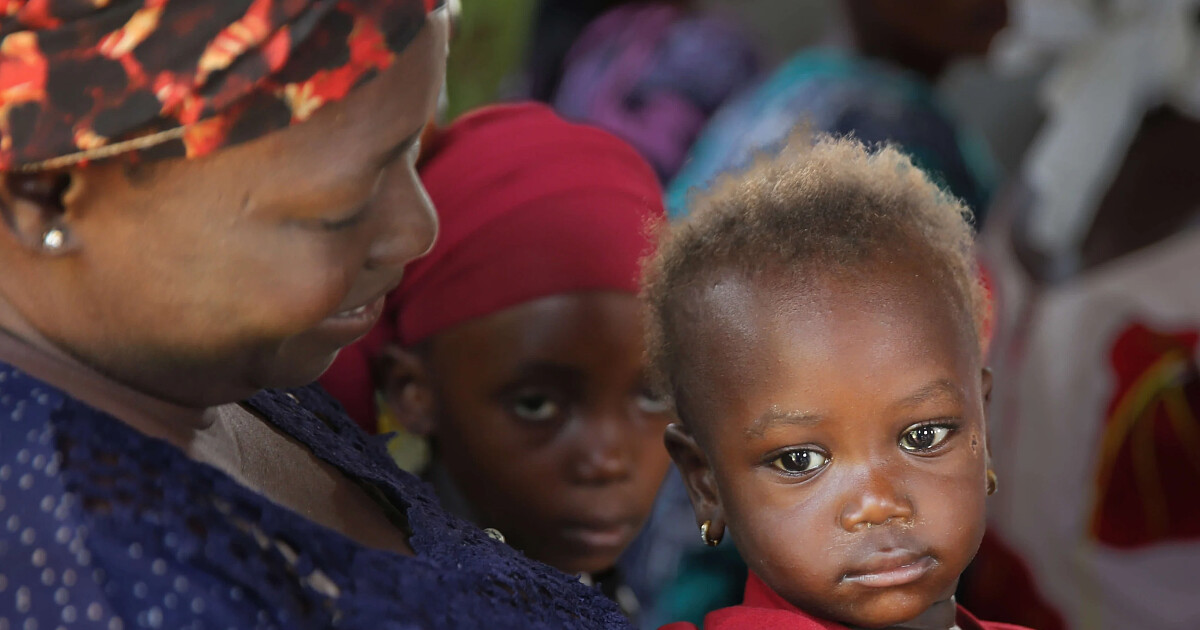
A Christian woman worships with her two daughters during a Sunday church service in Nigeria.
By Ralph Madugu
A Christian widow in Nigeria has sued the government of Bauchi State after her 17-year-old daughter allegedly vanished, was renamed, and was declared a Muslim convert while still legally a minor. The case fits a documented pattern in Nigeria’s predominantly Muslim north, where advocacy groups and UN experts have recorded the abduction, forced conversion and forced marriage of underage Christian girls, despite a constitution that guarantees every person the freedom to choose and change religion.
Filed on June 29 at the Federal High Court in Jos, the capital of Plateau State in Nigeria’s Middle Belt, the fundamental rights suit asks whether a northern state can recognize a child’s conversion and place her beyond her surviving parent’s reach.
The widow, Kumabe Zakari, is seeking the immediate release of her daughter, Faith Barnabas, from a state-run child welfare facility, along with 150 million naira, about $95,000, in damages for what she says are violations of her daughter’s constitutional rights.
Nigeria, Africa’s most populous country with more than 220 million people, is split almost evenly between Muslims and Christians. Twelve northern states, Bauchi among them, apply Islamic Sharia law, alongside secular courts in both civil and criminal cases. The dual system has produced repeated disputes over conversion, the minimum age of marriage, and custody of children, because Sharia courts often give weight to religious rulings that the country’s federal statutes reject.
The disappearance and the state’s response
Faith went missing from her grandmother’s home in Bauchi in April 2026 after sitting for university entrance examinations, according to the affidavit filed with the court. Her mother alleges that an adult man, Sadiq Ahmad Hussaini, had groomed the girl for years and on April 30 took her from Jos to an undisclosed location. Police later arrested Hussaini, who disclosed where the girl was being held, the filing states.
Ten days before that journey, on April 20, the family received a letter from the Bauchi State Shari’ah Commission stating that Faith had converted to Islam and taken the name Sa’adatu, the mother alleges. Police involvement led not to the girl’s return to her family but to her placement in the custody of the Bauchi State Orphans and Vulnerable Children Agency, known as BASOVCA, a government body responsible for children without parental care. Faith’s mother says the agency has refused to release Faith despite a May 20 interim order from a district court in Bauchi directing that the girl be handed to her mother.
The agency has barred the mother from seeing her daughter while permitting Hussaini to visit, the suit claims.
Named as respondents are the Police Service Commission, the Bauchi State Commissioner of Police, the Bauchi State Government, the state’s Attorney General, the Shari’ah Commission, BASOVCA, and Hussaini, whom court papers call the teenager’s “acclaimed boyfriend.”
The suit
The 13-point application asks the court to rule that a 17-year-old minor cannot independently exercise freedom of religion without parental consent, and that any effort to change Faith’s religion violates Sections 35, 37 and 38 of Nigeria’s 1999 Constitution, which protect personal liberty, family life, and freedom of thought, conscience and religion. Section 38(1) entitles every person to change his or her religion, wording that echoes Article 18 of the Universal Declaration of Human Rights and Article 18 of the International Covenant on Civil and Political Rights, which Nigeria ratified in 1993.
The application also seeks orders nullifying documents tied to the alleged conversion and injunctions barring state officials from pursuing the matter further. In the alternative, Zakari is asking for 50 million naira, about $36,000, from the police and 100 million, about $73,000, jointly from the other state respondents.
Her lawyers, Wholesome Attorneys, argue under the Bauchi State Child Protection Law 2023 and the federal Child Rights Act that parents are the sole legal guardians for decisions about a child’s religion. They cite Section 8 of the Bauchi law, under which the parental duty “shall be respected by all persons, bodies, institutions and authorities.” Warning of continuing harm, the lawyers told the court that “unless this Honourable Court intervenes urgently, the minor will continue to suffer psychological harm, brainwashing, and a flagrant violation of her constitutional rights.”
No hearing date has been set.
A recurring pattern in the north
The Child Rights Act, passed by Nigeria’s federal legislature in 2003 to give effect to the UN Convention on the Rights of the Child, sets 18 as the minimum age of marriage and defines anyone below that age as a child. Because children’s affairs fall to the states under Nigeria’s federal system, each state must adopt the law separately, and 11 northern states declined to do so for years, arguing that the 18-year threshold conflicts with Islamic practice. Bauchi domesticated a version of the law only in December 2023.
Child marriage remains widespread in the region, with Bauchi recording one of the country’s highest rates. UNICEF survey data from 2021 put the proportion of girls in Bauchi married before 18 at about 74 percent, one of the highest rates in the country.
Cases resembling Faith’s have surfaced in several northern states, suggesting a pattern.
In Adamawa State, 16-year-old Georgia Miracle went missing in March 2025 and was found renamed “Aisha” and about to be married, according to the news outlet Truth Nigeria. In Kaduna State, 14-year-old Queen Elizabeth Ayuba was converted, renamed Fatima, and married without her parents’ consent. And in Kano State, 15-year-old Ummi Tambaya disappeared in December 2025 and was traced to the custody of an official of the Hisbah, the Sharia religious police, who said she had converted willingly.
A police source in Yobe State was quoted as saying in May 2026 that records there documented more than 300 cases of Christian girls held and groomed for marriage to Muslim men.
In a formal communication to the Nigerian government on June 8, 2026, a group of independent UN experts, the Special Rapporteurs on violence against women and girls, on extrajudicial, summary or arbitrary executions, on minority issues, and on torture, together with the Working Group on Enforced or Involuntary Disappearances, cited the reported abduction, forced conversion and child marriage of a 13-year-old girl in Bauchi State among incidents of concern. They flagged alongside it a separate attack in which a 16-year-old girl’s hand was reportedly severed after her family rejected a forced marriage.
“Rampant”persecution of Christians
The experts wrote that violence targeting Christians and other religious minorities “continues to be rampant,” pointing to local interpretations of Sharia law in the 12 northern states and a long absence of effective access to justice. They said that “in many cases, those who resist are reportedly threatened, punished, disappeared or killed,” and gave the government 60 days to respond.
In October 2025 the United States redesignated Nigeria a “Country of Particular Concern” under its International Religious Freedom Act, a designation reserved for governments deemed to tolerate severe violations of religious liberty.
Members of the U.S. Congress have since introduced legislation seeking reports on persecution of Christians in Nigeria and sanctions on officials accused of enabling it.
On February 10, 2026, Rep. Chris Smith of New Jersey and Rep. Riley Moore of West Virginia, with four cosponsors, introduced the Nigeria Religious Freedom and Accountability Act of 2026 (H.R. 7457), which requires the Secretary of State to report to Congress on U.S. efforts to address religious persecution and mass atrocities in Nigeria and to identify individuals and entities sanctioned or under consideration for sanction under the Global Magnitsky Human Rights Accountability Act.