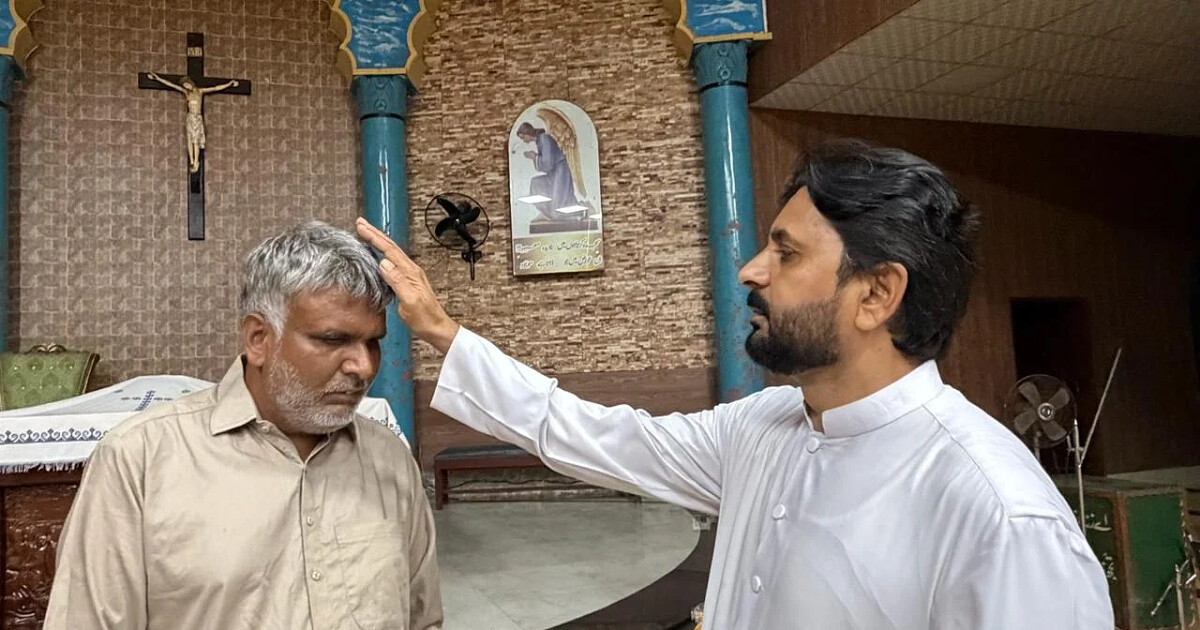
Nadeem Yousaf is blessed by his priest after being freed. csi
In a landmark case, a court in Pakistan acquitted 51-year-old Nadeem Yousaf on June 22 and ordered his release, ending his 10-month prison ordeal and ensuring that justice was finally served.
Yousaf, who has been blind since birth, had been charged under Section 295-C of Pakistan’s blasphemy laws, which criminalize alleged insults against the prophet of Islam and carry a mandatory death sentence. But the prosecution failed to prove their case, resulting in the judge announcing Yousaf’s acquittal, to the delight of his supporters in the courtroom.
False accusations
Despite his disability, Yousaf was able to earn a living and support his family through the weighing scale business he operated at Nawaz Sharif Park in Lahore. But his normal routine was shattered on August 21, 2025, when predatory park contractors, desperate to steal his business spot and evade debts they owed him, brought false accusations against Yousaf, local partners of Christian Solidarity International (CSI) report.
At the trial, the defense team, led by Advocate Javed Sahotra, succeeded in dismantling the prosecution’s case, including the crucial timeline of events. According to the police report, the allegedly blasphemous incident occurred at 11 p.m. despite the park having closed at 9 p.m., Morning Star News reported.
“Through meticulous cross-examination and digital call data records, Advocate Sahotra proved that the accusers and the police were never even at the park at the alleged time of the incident, exposing the entire case as a cruel hoax driven by greed,” CSI’s partners said.
Support for family
Yousaf’s elderly mother, Martha, and his three sisters stood resolutely by his side following the shock of his arrest and throughout his 10-month ordeal, but they were filled with fear for his safety and their own future.
Martha told Morning Star News that while in police custody Yousaf was beaten and pressured to confess to a crime he did not commit.
Behind the scenes, CSI extended a vital lifeline, funding the legal battle and providing financial aid to prevent Martha and her daughters sinking into poverty and isolation.
When the innocent verdict was finally read aloud, the family shed tears of relief and joy, CSI’s partners report. They comment that for human rights advocates, the acquittal offers encouragement that a well-presented legal defense can overturn even the most dangerous of charges.
Pastoral blessing
Yousaf finally walked free from prison on June 23 and was received by his family and members of the community.
Following his homecoming, Yousaf, his mother and his sisters visited the church where they worshiped to praise God for his liberation.
“In a deeply moving and emotional service, Nadeem knelt to thank God for delivering him from the shadow of death, after which Father Shafiq stepped forward to pray over him and give him a special pastoral blessing,” our partners reported.
Yousaf spoke candidly about what he had endured in prison and spoke of his newfound freedom as a miracle.
“When the judge said the word ‘acquitted,’ it felt like a heavy stone was lifted off my chest, and I could breathe truly for the first time in 10 months,” he said.
“I am not angry at those who harmed me; I am just filled with pure joy to hold my mother Martha’s hand again, be surrounded by my sisters and receive Father Shafiq’s blessing.”
Weaponizing of blasphemy laws
Pakistan’s harsh blasphemy laws that came into force in 1987 criminalize a range of offenses against Islam, including defiling the Qur’an and insulting the prophet of Islam. The latter carries the death sentence.
The Human Rights Commission of Pakistan’s State of Human Rights in 2025 report states that 812 people in Punjab were imprisoned on blasphemy-related charges in 2025. This figure includes 796 men, 15 women and one juvenile.
The blasphemy laws have created a climate of impunity for religious terror in Pakistan. Bad actors can easily weaponize false blasphemy accusations, which are difficult to disprove, and these can quickly give rise to religious conflict as mobs take the law into their own hands.
Religious minorities and people of low social status are particularly vulnerable to abuses of the blasphemy laws and are often unable to afford a legal defense.
The number of blasphemy prosecutions in Pakistan is surging – in part owing to a sharp increase in allegations of “online blasphemy” brought by vigilante groups against young people, often Christians.
Learn more about CSI’s work in Pakistan here.