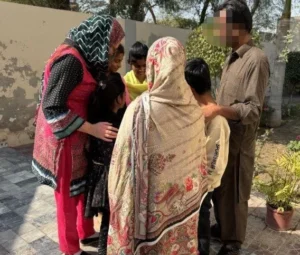
Tabish N., middle, had to wait years to officially be recognized as a Christian. csi
Tabish N. converted to Christianity in 2008 shortly before her marriage to a Catholic man, Khurram Shahzad. But it has taken until now for Tabish to win the right to have her new religion entered on her official identification papers. Christian Solidarity International (CSI) provided legal support to Tabish to fight her case.
The Lahore High Court on July 1 ordered the National Database and Registration Authority (NADRA) to issue Tabish a new identity card that identifies her as a Christian married to a Christian man. Until now her legal identity has been Muslim, as she was born into that faith.
Ruling creates precedent
It is believed to be the first time a court has directed the NADRA to change a convert’s religion on their identity card.
Congratulating the legal team following the verdict, CSI’s local partner said, “I salute your courage in this challenging case. You have changed the course of history.
“May this case prove to be a beacon of light for many people in times to come.”
Under Pakistani law, it is technically possible for individuals to change their religion. But people who renounce Islam – the state religion – are considered apostates. Within Islam there are schools of thought that consider apostasy an offense that merits the death penalty.
Those who turn their backs on Islam may also face prosecution under the country’s stringent blasphemy laws. And they will have to contend with the huge social stigma attached to renouncing the Muslim faith.
Risk of retaliation
Tabish’s attorney welcomed the ruling, which he said was a “milestone for religious freedom in Pakistan,” and “affirms Article 20 of the Constitution, which guarantees freedom to profess and practice one’s religion,” according to UCA News.
The attorney added that a fear of retaliation prevented most converts to Christianity from filing petitions like Tabish.
“People are afraid due to pressure from extremist elements and society. In most such marriages, Christians convert to Islam to protect themselves from persecution,” he told the Catholic Asian news website.
Cut off by family
Tabish, who works as a cleaner, grew up in a strict Muslim family. At school, she was introduced to Christianity by Christian friends. Later, she met and fell in love with a Catholic friend of her brother. The couple was married by a pastor in a simple ceremony in 2008 with none of her family present. Following the wedding, Tabish’s family cut all ties with her.
Since their marriage Tabish and Shahzad have lived in fear of Tabish’s status as a convert being found out. The couple could not stay with his family, as tradition demands, because his parents were too afraid of harboring a convert from Islam. Tabish and Shahzad, who now have five children, have had to move home several times for their own safety.
“I have always been very afraid in my heart. It is difficult that we constantly have to hide and cannot openly say who we are,” Shahzad told CSI earlier this year.
He said that whenever people found out that Tabish was an ex-Muslim, they would demand that he would “return” her to Islam.
Children discriminated against
Matters recently escalated, when the children’s teachers found out about Tabish’s background, resulting in them being discriminated against at school.
Since their marriage, Tabish has been trying to change her surname on her identity card, which also requires updating her religion in official records. The first time she attempted this at the government office, she was surrounded by a group of men who warned her not to proceed, forcing her to flee in fear. She tried twice more, but the authorities refused to make the change.
This is now causing problems for their eldest daughter, who must register for her state exams. Until her mother’s personal details have been updated, she is unable to do so.
“We hope this revolutionary verdict paves the way for a better life for this family and addresses the legal hurdles faced by their children,” CSI’s partner told UCA News.
“Finally, their basic human rights have been secured.”