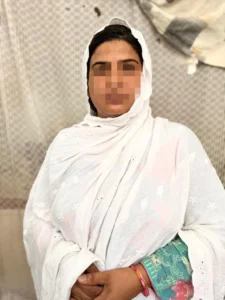
S. Bibi lives with her husband, who is fighting cancer, and their children in Pakistan. csi
S. Bibi, a 38-year-old Christian woman from a small town in Pakistan’s Punjab province, is fighting a legal battle with the support of CSI after being deceived into legally converting to Islam and forcibly married by a Muslim man who took advantage of her poverty. Her case raises fresh concerns about the targeting of vulnerable Christian and Hindu women in the predominantly Muslim country.
Bibi has worked tirelessly to support her family and pay medical bills
Bibi is employed as a sanitation worker at the University of Veterinary and Animal Sciences (UVAS) in Patoki, a city in Punjab’s Kasur District. She has been the primary breadwinner for her family, which includes her husband, Masih, who is battling blood cancer, and their three children aged 18, 17 and 15. Masih, despite his illness, works as a rickshaw driver when his health permits.
In early 2025, as Masih’s health deteriorated and doctors advised urgent surgery, Bibi was left with no means to pay for treatment. She turned to colleagues at the university for help. One of them, Muhammad Asif, a security guard, offered assistance. Illiterate and desperate, Bibi trusted him when he told her to provide her thumbprint for documents that he claimed were needed for financial support.
In reality, the documents were a certificate of marriage to Asif and a declaration claiming that she had converted to Islam.
Bibi’s colleague abducted and assaulted her, but police refused to respond
On February 14, while Bibi was at work, Asif filed the documents and abducted her shortly after. He held her in captivity at an undisclosed location for eight days, during which time he repeatedly raped her.
Bibi later managed to escape and returned to her family. However, when the family approached the police to file a report, the officials refused to accept her case.
The family says Asif is supported by local Islamic hardliners who have shielded him from arrest. His supporters continue to issue threats to Bibi, demanding that she return to him or face violence.
CSI provides legal and financial help
Already overwhelmed by the costs of her husband’s treatment, the family struggled to figure out how to respond. It was during this time that they reached out to CSI, which has been working on cases involving forced conversions in the area. CSI stepped in with legal and financial assistance.
A case has now been filed in court seeking the annulment of the marriage and the arrest of Asif.
Persistent threat of forced conversion faces women from religious minorities in Pakistan
Forced conversions remain a persistent and serious concern for religious minorities in Pakistan, particularly for Christian and Hindu women from low-income communities.
Human rights organisations estimate that each year, around 1,000 non-Muslim girls and women, primarily Christians and Hindus, are forced to convert to Islam and marry Muslim men. About 70% of them are Christian, according to Pakistan’s Dawn newspaper.
These girls and women are mostly abducted, subjected to pressure or violence, and then married off to older Muslim men, sometimes within days of disappearance.
Police routinely refuse to register cases or investigate thoroughly, especially when the accused are affiliated with powerful religious or political networks.
“We are deeply troubled to hear that girls as young as 13 are being kidnapped from their families, trafficked to locations far from their homes, made to marry men sometimes twice their age, and coerced to convert to Islam,” UN experts said in a statement in January 2023, urging the government to take action, according to Al Jazeera.
Islamic groups have guided Pakistan in practice and policy for decades
Islamic groups gained lasting power and influence largely during the rule of General Zia-ul-Haq, who led Pakistan from 1977 to 1988. Zia came to power through a military coup and launched a state-led programme of Islamisation to legitimise his rule. His government systematically integrated Islamic principles into the legal system, education and public policy.
During this period, religious parties and clerics were granted unprecedented access to state institutions. Zia introduced the Hudood Ordinances, made the blasphemy laws more stringent, and promoted sharia courts, all of which expanded the role of conservative Islamic jurisprudence in everyday life.
Madrassas – many funded by Gulf countries during the Afghan jihad of the 1980s – multiplied under state protection. These seminaries spread a conservative interpretation of Islam and produced a loyal base for religious political groups and militant factions.
The state also openly backed jihadist groups to fight in Afghanistan against Soviet forces, funnelling weapons, money and recruits with the help of the United States and Saudi Arabia. This further empowered the religious networks, many of which later turned into pressure groups or political actors within Pakistan.
By the end of Zia’s rule, Islamic groups had moved from the margins to the mainstream. Their influence continues today.
Freedom of religion is promised, but not provided, in Pakistan
While Pakistan’s constitution guarantees freedom of religion, implementation on the ground remains weak. Victims and their families face threats, legal intimidation and social ostracisation if they try to challenge the conversion or marriage in court.
Sindh and Punjab provinces, as well as the federal government, have previously proposed legislation to curb forced conversions, but these efforts have largely stalled due to political resistance from religious groups.
As Bibi and her family remain under threat, waiting for the courts to act and for any sign of justice in a system that has so far failed them, they ask fellow Christians in Pakistan and abroad to keep them in their prayers.
Learn more about CSI’s work supporting Christians in Pakistan here.