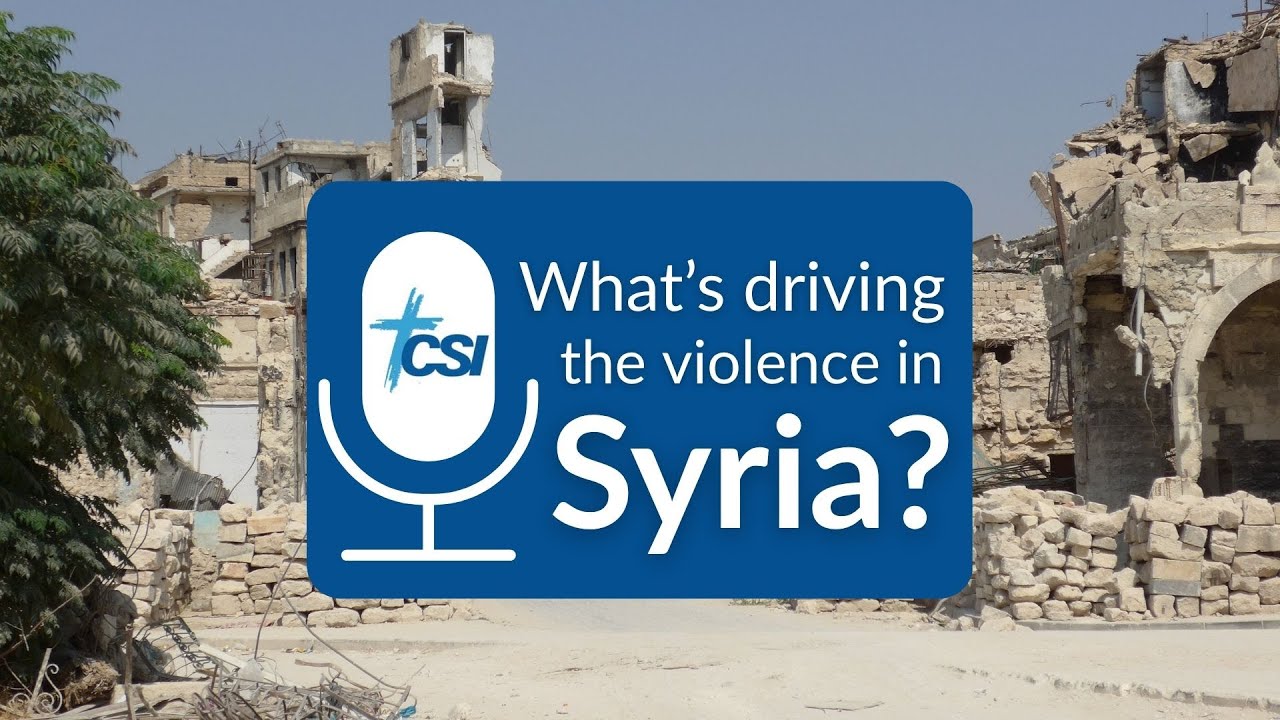
Image background: CSI visited Aleppo in 2017, under the brutal Assad regime that preceded the HTS takeover of Syria in December 2024. csi
The Christian Solidarity Podcast: Violence grows against religious minorities in Syria
In the second episode of the Christian Solidarity Podcast, host Abi McDougal and Dr. Joel Veldkamp, CSI’s director for public advocacy, discuss the existential threats facing religious minorities in Syria. The conversation examines religiously motivated attacks under al-Sharaa’s new regime and the Sunni jihadist ideology driving the violence. They look at the various struggles faced by Christians, Druzes, and Alawites, and emphasize the need for international action to protect these vulnerable groups.
What is driving the violence in Syria? | Christian Solidarity Podcast | Ep. 2
Transcript
Abi: On December 8, 2024, the people of Syria rejoiced as their brutal dictator,
Bashar al-Assad, fled the country after 24 years at its helm.
Syrians were tasting freedom.
So how did that time of celebration morph into the horrific headlines we’ve now seen only
eight months later?
In the same city where the apostle Paul came to faith in Christ,
Christians worshipping in their church in Damascus were killed by a suicide bombing this
June.
Back in March, along the coast, more than 1,000 Alawite Syrians were slaughtered in what
the new government claims were isolated acts of violence.
And just in July, another wave of attacks in southern Syria’s predominantly Druze Suwayda
region also killed well over 1,000 people.
So now that Assad is gone, what is driving the violence in Syria?
My name is Abi and I’m your host here at the Christian Solidarity Podcast, where we stand
as one with the body of Christ facing persecution around the world.
At Christian Solidarity International (CSI) we partner with local Christian organizations
to support religious freedom and human dignity for everyone.
Our goal is to help followers of Christ of all different traditions stand together with
those facing persecution.
In a 24-7 news cycle, can feel overwhelming to even know where to begin.
So we want to help you stay informed, give practically, pray consistently, and speak out
about the suffering happening in the world with our hope always in Christ’s ultimate
redemption.
Our partners are located in Sudan, Nigeria, Pakistan, and more.
And today, we’re talking about Syria.
On the podcast today with me is Dr.
Joel Veldkamp, CSI’s director for public advocacy.
He has his PhD in history from the Geneva Graduate Institute for a dissertation about the
Christians of Aleppo who were living in Syria during the French Mandate period between
World War I and World War II.
And he also has firsthand experience living in Syria.
He was working there in 2011 when the Arab Spring uprisings began.
So Joel, thank you so much for speaking with us today.
And now we are going to jump right in.
Okay, so we have been seeing a lot of headlines about Syria recently and there’s been a
latest round of violence just this month in July happening in the Suwayda region of Syria.
Joel, can you give us an introduction to what that’s been about?
Joel: Sure, the Suwayda region of Syria is special because the people who live there are almost
This is an offshoot of Shiite Islam that began around the 11th century, they make up about
Now, during the Syrian Civil War, they weren’t with…
government with the dictatorship per se, but they formed militias to defend themselves
against the jihadists who formed the backbone of the rebellion against the dictatorship.
Why was this necessary?
Because in the Sunni Muslim jihadist worldview, druzes are considered as heretics, as
people who have departed from the truth of Islam who should be killed or enslaved.
That’s the…
ruling on Islamic law that these groups follow.
So they had to defend themselves during the civil war and they formed their own militias
and their own self-defense groups to basically protect Suwayda from outsiders.
When the Assad regime fell in December, they participated in driving Syrian troops out of
their region.
And since then,
Suwayda has basically been under the control of these Druze militias.
They haven’t declared independence or anything like that, but they’ve just kind of been in
this quiet standoff with the new Syrian government, which was formed by the jihadist
groups that were fighting against the Assad dictatorship.
Now what happened last month was this standoff turned into a hot conflict.
The Syrian government sent troops into Suwayda to try to take control over Suwayda.
Ostensibly, this was in response to fighting between Druzes and other Muslims in the area.
ah I don’t buy it, but time will tell.
In any case, the Syrian government used this as a reason to send its own troops into
Suwayda to try to take Suwayda over.
And as they went, they committed numerous atrocities against Druzes.
I’ve seen terrible videos online of men being shot as they are forced to jump off a balcony, for example, other forms of executions, uh older Druze men having their mustaches forcibly shaved off in the Druze religion, having the mustache is very important for men.
So this was a clear case of religious hatred, motivating religious violence by government troops against Druze civilians.
And this violence went on for about a week.
And in the end, the only thing that stopped this from turning into a much larger massacre
was that Israel started bombing the Syrian government and the Syrian troops that were on
their way to Suwayda and forced them to withdraw.
So now we’re basically back to where we were.
The Syrian government is determined to conquer Suwayda and it seems the only way they have
to do that is by sending in troops who are going to commit atrocities against Druze
civilians.
And the Druze militias are not going to accept this.
So the stage is set for further mass killings, I’m afraid.
Abi: Wow, yeah.
Yeah, it’s really horrific to even hear the stories that you talked about.
even before this happened, we actually had an event in Geneva in Switzerland at the UN
Human Rights Council focused on the situation for religious minorities in Syria.
already happening and that was before this last attack had taken place.
So even before this had happened, why did we feel like this was relevant and necessary?
Can you explain some of the thinking that went into hosting this event at the beginning of
July?
Joel: Sure.
So maybe we should say that the fall of the Assad regime in December was almost completely
unexpected by everyone.
No one really saw this coming.
That in just 11 days these rebel groups that had been confined to a tiny little province
of Syria called Idlib
could march across the whole country and take the capital city of Damascus.
And the fear was, at the time, that these groups would carry out atrocities against
religious minorities, like the Druzes, like the Alawites, like Christians.
But at the time, they didn’t.
At the time, they were very disciplined, they didn’t hurt hardly any civilians, and they
were constantly broadcasting these messages that, you don’t have to be afraid of us, we’re
not going to hurt you, the new Syria will be for all Syrians, it doesn’t matter what your
religion is.
And that had basically been the only reason that anyone was supporting the Assad regime in
So when they took that fear away, the Assad regime crumbled very quickly.
And after that, everyone was just kind of hoping that the new regime would keep its
promises.
And for a few months they did.
But the dam really broke in March.
In March, the Syrian government organized horrific massacres.
of a religious group called the Alawites in the coastal region of Syria, and even beyond
the coastal region as well, that doesn’t get talked about as much, but in Damascus there
were massacres of Alawites, in Hama province there were massacres of Alawites, organized
by government troops.
We don’t know exactly how many people were killed, but it’s in the thousands.
This is like something out of the Yugoslav War.
It’s among the worst atrocities of the entire Syrian civil war going back to 2011.
And what was weird was, directly after that, there was a session of the Human Rights
Council at the United Nations, where you and I both were, Abi, and both of us heard the
members of the UN Commission of Inquiry on Syria presenting to the whole Human Rights
Council.
We were at events about Syria.
We heard different diplomatic delegations talking about Syria.
No one was highlighting this.
No one really wanted to talk about it.
And so we CSI decided, oh,
we better start talking about it at the UN.
So that was the impetus for us to have this event on July 1st, where we brought in Fabrice
Balanche and Joshua Landis, two of the world’s best experts on Syria, to talk about the
threat to religious minorities under the new regime.
And unfortunately, the things they had to say at that event have proved very prophetic.
Abi: Yeah. Yeah.
Well, and even with the timing at that Human Rights Council session also, you we had the
statement on on Syria with stating our concerns stating this warning of uh potential
genocide for the Alawite population in Syria.
And we had planned that well in advance.
But the day that we actually delivered that at the Human Rights Council session was the
day after the church bombing in
Damascus while that was not carried out with the same length and scale as the attacks on
the Druze and the Alawites have been, it was part of this concern that we’ve had that the
government is not protecting religious minorities and that the situation seems to be continually worsening and getting
more more serious.
When we’re talking about religious minorities in Syria, we have mentioned so far
Christians, Druzes, Alawites.
Can you explain a little bit about who each of those groups are?
Joel: Sure.
So Alawites and Druzes are both offshoots of Islam, of Shiite Islam to be specific, but
they’re quite unique, we can say.
We probably wouldn’t recognize much about them that’s familiar that we know about other
Muslim groups.
Both of them, for example, don’t seek converts, and they only marry within their own
groups.
And that’s partly because they believe in reincarnation.
They believe you have to be born an Alawite or you have to be born a Druze.
Most of them don’t keep Sharia law the same way that most Muslims do.
It’s not to say that they aren’t religious, they’re very religious, but their religion is
very different to what we would know as mainstream Islam.
So the Alawites live mostly on the coast of Syria, the Mediterranean coast, because that’s
a rather mountainous region.
And historically that’s been a place where they could be safe from the Islamic empires
that ruled Syria and from other people who might want to hurt them.
Same with the Druzes.
They live in southern Syria, again, in a mountainous region called…
Druze Mountain or Mountain of the Arabs, if you want to be more politically correct as a
Syrian.
But they both are what we call compact minorities.
They all kind of live together in the same place.
Christians, of course, have been in Syria since before the Apostle Paul converted to
Christianity.
And today they kind of live everywhere in Syria, mostly in cities like Damascus, Aleppo,
Homs, but also in smaller villages.
particularly in the mountains north of Damascus or in the plains south of Damascus in
northeast Syria, where many of them are descendants of survivors of
the great Armenian and Assyrian genocides
the great genocide of Christians that the Ottoman Empire carried out during World War I.
There’s also an area called the Valley of the Christians, which is the only Christian
majority area in Syria.
In most places where Christians live, they’re a minority and they live alongside their
Muslim neighbors.
Abi: So for the Christians in Syria, can you tell us a little about them and paint the picture
of who are these people?
Joel: Sure, so Christians of course have been in Syria for nearly 2,000 years since before the
Apostle Paul converted to Christianity.
There were already Christians in Damascus and in other places in Syria.
So Christianity in Syria really goes back to the very beginnings of the church.
And
Most Christians in Syria speak Arabic, but there are also many who speak Armenian, again
because they’re descendants of survivors of the Armenian genocide who found refuge in
Syria after the genocide.
There are also some Christians in Syria who speak Aramaic or versions of Aramaic, which
was the language that Jesus himself spoke, as best as we can tell.
And that just points again to how ancient Christianity is in Syria.
They belong to 11 different churches, varieties of Catholicism or Orthodoxy, but there are
also uh evangelicals and Protestants who live in Syria.
Abi: Yeah, and so as we’re looking at the situation now, are Christians directly targeted?
Are they the focus of these attacks or how does that play in?
How does it compare for the situation for Christians versus for Druzes and Alawites, which
sounds like it’s a little bit different.
Joel: For the most part, Christians have not yet been directly targeted by the new government,
and that’s for several reasons.
One is that Christians were not as closely associated with the Assad dictatorship as
Alawites were, for example.
President Assad himself was an Alawite, so it’s easy to pin his crimes, and there were
many horrible crimes that he committed.
It’s easy to pin his crimes on the Alawite community.
Another reason is that, again, in this
Islamic jihadist worldview, Christians have a place.
If Christians are willing to submit to Islamic rule and pay extra taxes and not interfere
with the practice of Islam, then they should be allowed to live in peace.
Whereas there’s no such provisions for Alawites and Druzes, again, for these extreme
groups that formed the backbone of the rebel coalition that took power in December, not
for all Muslims.
So they have that kind of layer of protection.
Also, the new Syrian government really wants approval from the West and they need the
support of the United States and Europe and other Western countries in order to rebuild
and consolidate their power.
And they know that violence against Christians can really hurt that effort.
So for the time being, they’re being very careful with the Christians.
But that’s not to say that everything is good.
As you mentioned, Abi, there was a horrendous church bombing on June 22 that killed
between 25 and 30 Christians who were at worship when the suicide bomber detonated himself
inside their sanctuary.
That’s something that has never happened before in Syria.
Never.
Syria has almost always been a safe place for Christians.
And this event really has sent an awful signal.
to Christians of Syria that this place is not going to be safe for you anymore.
What’s worse is that the government’s response to this attack was really not convincing.
They immediately blamed ISIS for the attack, like way earlier than it would have been
possible to know who was responsible for the attack.
They said it was ISIS.
And within 24 hours, they rounded up all these suspects who they blamed the attack on.
um That was not taken very seriously, I have to say, by most Syrians.
No senior government officials, including the president, went to the funeral of these
victims.
None of them visited the church.
And the president refused to use the Arabic word for martyrs to describe the people who
were killed in the church.
And that’s not a coincidence.
He’s following Salafist Jihadist teaching in refusing to honor Christian victims of
violence this way.
So
This is a very bad sign and it’s a sign to Christians that they’re no longer going to be
safe in Syria.
It’s also a sign to people in Syria who might want to hurt Christians that the door is
kind of open for this.
Abi: Yeah.
And despite the vast differences in their beliefs, from what we’ve talked about and what
we’ve heard from our partners, it sounds like really Christians and Druzes and Alawites
are in some ways kind of coming together to say that they have shared concerns, right?
And they’re not voicing these concerns publicly, but the concerns are the same.
Can you weigh in a little bit on that and what that relationship is between these groups?
Joel: Sure, and I would say it’s not just between these three religious groups, but there are
many, many Syrians, including Muslim Syrians, who are extremely concerned about the
direction that their country is going, who don’t want a hard-line Islamic regime to rule
Syria, who don’t want a new dictatorship in Syria.
And to their credit, some of them are protesting when government troops were attacking
Suwayda a few weeks ago, two weeks ago now.
There was a protest in Damascus of ordinary Syrians, Muslim Syrians, Christian Syrians,
coming together saying it is haram for Syrians to shed the blood of other Syrians.
That was their message.
It’s forbidden.
This should not be happening.
And unfortunately, they were attacked by pro-government thugs who beat them up and
dispersed them.
So we are entering a very tense time in Syria,
and we’re going to need lots of brave Syrians to speak up for the future that they want to
have in their country.
But certainly in Suwayda, we’re seeing a lot of cooperation between church leaders and
Druze leaders for the good of the people who live in that province.
And yeah, we have to hope that these sorts of cooperations will be effective.
Abi: Before December, all of these religious minorities were already living in Syria under the
Assad regime.
And so what was it like for them at that point?
What did life look like prior to this takeover by HTS and these Islamist groups?
Joel: So as you said before, Abi, when the regime fell, almost all Syrians were rejoicing
because the Assad regime was really brutal and really terrible.
It was one of the worst police states in the world.
Its crimes were among the worst of the 21st century.
This is a dictator who launched chemical weapons attacks on civilian neighborhoods in
Damascus, killing thousands of people.
This is a dictator who disappeared
tens of thousands, maybe hundreds of thousands of Syrians into his labyrinth, his maze of
prisons from which very few Syrians emerged alive.
So this was a regime where everyone had to be careful all the time not to say the wrong
thing, not to trust anybody.
It was not a happy political situation, we can say.
But the regime
as I said before, was headed by an Alawite.
And for that reason, he had a very strong interest in Syria remaining a secular state and
in religious minorities having a stake in that state.
His kind of coalition of support included religious minorities who were afraid of a
jihadist takeover of Syria and who clung to his regime for protection.
That was kind of his ace in the hole, that if you lose me, you’re going to lose your
protection.
So I wouldn’t say anyone or very many Christians, Alawites or Druzes really loved the
Assad regime.
But for many, he was seen as a better alternative than ISIS, for example, or than Jabhat
al-Nusra, the group that eventually became HTS, which eventually took over the country in
December.
So we’re in uncharted territory here.
Abi: Yeah, and so then today,
what is driving the violence against religious minorities in Syria?
Joel: I think we should not overlook this worldview of this, what I might call the Salafist
Jihadist worldview for lack of better terms, that really classifies Syrians according to
their religious group.
So on top of this hierarchy, you have Sunni Muslims, on an inferior rung you have
Christians who should be allowed to remain in an Islamic state, but not as equals.
And then down below you have Alawites and Druzes who have to be
killed or enslaved or driven out.
There’s no place for them in an Islamic state.
This is not the program that the Syrian government is implementing directly, but this is
the ideology that the fighters who took control of Syria in December have been marinating
in for almost a decade and a half.
Many, for example, many brigades on the rebel groups during the civil war named themselves
after Ibn Taymiyyah, a Sunni Muslim Islamic scholar
from the 13th century, who famously issued a fatwa, a religious ruling, saying that it is
necessary to kill Alawites.
This is the name that they took for themselves, right?
This is how they framed the entire 14-year-long civil war.
We are Muslims fighting against the Alawites to set up an Islamic state.
And that attitude, that mindset has not gone away,
regardless of what public statements the new Syrian president Ahmed al-Sharaa has made
saying that all Syrians can live here, everyone’s going to be safe.
His soldiers on the street who are now the police, who are now the army, who are now uh
border guards, what have you, they still have this mindset and in that situation it’s
going to be very difficult to prevent more violence like the kind that we saw in Suwayda
two weeks ago.
Abi: Yep.
So what do you think we should be watching for and expecting in the future?
Joel: Things look very bad right now, to be honest.
Something that we haven’t discussed yet, just as Suwayda province in the south is kind of
an autonomous region, most of northeast Syria is still under the control of the new Syrian
government.
It’s under the control of the Syrian Democratic Forces, who are led by Syrian Kurds.
Damascus likewise wants to retake this territory and Syrian Kurds likewise are kind of…
saying no without saying no.
There’s this standoff between the two sides and I’m really concerned about what will
happen when that clash comes.
That’s going to be very bad for Christians in northeast Syria, particularly and for the
Kurds.
But so we have this kaleidoscope of conflicts along religious lines centered against a new
government in Damascus that emerged
from a jihadist coalition that sees most of these groups as infidels, as heretics.
This is really an explosive situation.
So I’m afraid we should expect more mass killings in the months to come.
Even without mass killings, we’re seeing a steady stream of Alawite women, for example,
who are being kidnapped and never seen again.
We’re seeing Christians and Druzes and Alawites being kidnapped and showing up dead a few
days later.
We’re seeing Alawites being driven off of their lands by their Sunni neighbors without any
kind of accountability.
So there is this slow driving people out of the country.
And already in Lebanon, I’d have to check the statistics, but I think there are a hundred
thousand new Syrian refugees since December in Lebanon alone because of these new
conflicts.
So I’m afraid we’re heading towards, if not, uh
total genocide than at the very least slow ethnic cleansing.
Abi: Yeah. Yeah, it’s been such a roller coaster.
Even just hearing the reports from CSI’s partners in Syria, the initial excitement after
Assad left the country and then moving to the concerns with the massacres of the Alawites
in March, but then moving to excitement again with the sanctions being lifted, which is something that
CSI advocated for years for these broad general sanctions to go away because of how absolutely horrible the economic situation was.
But then again, it was followed and surrounded by these attacks on the Druze and the
bombing of the church in Damascus and the attacks in general in the Suwayda region.
And so with all of that, it’s a country that’s already been through so much.
I remember 10 years ago seeing the headlines about Syria
And now it’s like this moment of hope that has then plunged into another unfolding disaster.
So what can people listening do to speak out about this, to help to try to curb this tide that we see happening right now?
Joel: The only thing that’s going to make a difference at this stage is if the United States and
the European Union really press the Syrian government to stop, to stop massacring
religious minorities in no uncertain terms.
So far, they don’t seem inclined to do that.
The United States, for some reason, seems to have gone all in on Ahmed al-Sharaa.
They seem to think that he’s their guy who’s going to deliver for them.
to the extent that when Israel bombed Syrian forces in July to stop them from massacring
the Druzes, the United States was publicly upset at Israel for this, saying, don’t bomb Damascus, don’t bomb our guy, what are you doing?
You’re ruining things for us.
And unfortunately, this fits a pattern in American foreign policy that we’ve seen for
decades, which is that American policymakers keep coming around to the idea that they can
use Sunni jihadists
for their own benefit.
They are wrong.
They’ve been wrong before and they’re wrong this time and they’re going to regret it.
This is a message that anyone who’s in touch with their lawmakers needs to be bringing to
their lawmakers.
At CSI, we’ll soon be launching the petition for a specific Syrian Christian man who’s in
prison, the former mayor of a town called Sadad.
His name is Suleiman Khalil.
He’s been in prison for six months now with no access to a lawyer, no charges, and he
needs to be let out.
So we’re going to be campaigning for him and we invite you to join us in that campaign to
sign our petition.
And if you do, you’ll connect with us and we’ll keep you informed about other advocacy
actions you can take in the future.
Abi: Thank you, Joel.
That’s all for today.
If you have comments or questions, we’d love to hear from you.
You can comment directly on your listening platform or contact us through our website at csi-int.org.
If this episode was encouraging, convicting, or eye-opening, be sure to share it with a friend and hit subscribe so that you can get updates as they come out.
I’m Abi McDougal and this is the Christian Solidarity Podcast.
Thank you for listening.