
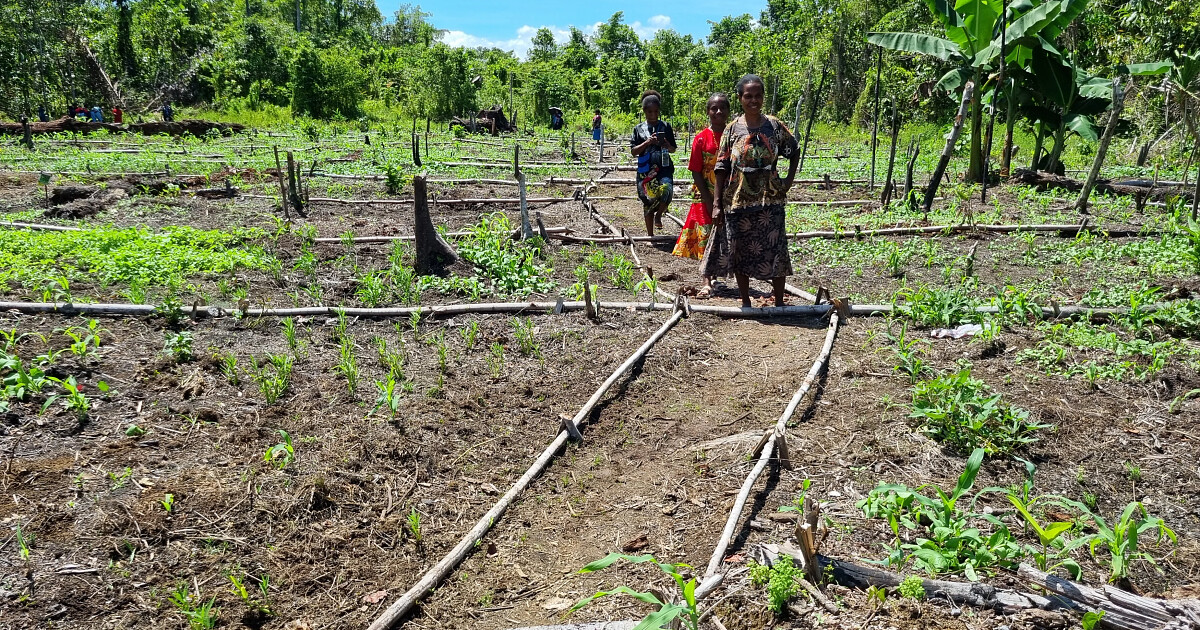
IDPs in Nabire, where many have fled from the conflict in Intan Jaya in the Papua Highlands. csi
Four violent incidents occurred in four days in Intan Jaya, a remote regency in Central Papua province on the western half of the island of New Guinea, according to media reports.
Indonesia governs the region, which was incorporated into the country in 1969 through a UN-supervised vote that many Papuans and outside observers regard as flawed. An armed independence campaign has continued in various forms since, and fighting between the Indonesian military, locally known by its initials TNI, and the West Papua National Liberation Army, the armed wing of the Free Papua Movement, now appears to be escalating in Intan Jaya.
Three killings
On the night of July 2, Melkiana Duwitau, a 31-year-old pregnant woman, was shot dead inside her home in Wandoga, a village in Sugapa district, according to Mediarealita News and Teropong Indonesia News.
A preliminary investigation by Indonesia’s National Commission on Human Rights, locally known as Komnas HAM, found she was likely struck by a stray round, with a strong possibility it originated from a nearby TNI post. She was rushed to hospital, but neither she nor her unborn child survived.
On July 1, the body of Okto Tigau, a 19-year-old, was found near the Rajawali Habema military post in Mamba village, next to Wandoga. He had multiple gunshot wounds to the chest and abdomen, a severed left ear, and injuries consistent with torture. The military confirmed his death and said he was a deputy operations commander of the West Papua National Liberation Army, claiming that a machete was found near his body. The Jakarta Post reported that the TNI had previously accused him of belonging to the Free Papua Movement.
On June 29, Elianus Agimbau, a 20-year-old evangelist with the Damsik Kupia congregation of the Evangelical Tabernacle Church, was killed in Agisiga district. Intan Jaya Regent Aner Maiseni was quoted as saying that Agimbau had been traveling toward Sugapa, the regency capital, as security conditions in the area deteriorated. His body was found the following day in bushes near a military post.
The West Papua chapter of Komnas HAM has not established who fired the shot that killed him. A relative, Marthen Weya, told UCA News that the family regarded Agimbau as a shepherd entrusted with caring for his flock, and that their one hope was for the case to be tried and processed legally so the family could obtain justice.
Grenade attacks on a church
Also on June 29, two further gunfights in Titigi village, Sugapa, left two civilians injured and damaged a car belonging to a local church. The injured were identified as Daud Hagisimijau and Kiko Hagisimijau, from Titigi village. They were shot while operating an excavator at the construction site of St. Francis Xavier Catholic church.
Komnas HAM is reportedly investigating eight separate violent incidents in the regency, including grenade attacks that struck St. Paulus Nabuni Catholic church and a residential neighborhood in Agisiga district, wounding six civilians, in May.
The commission’s Papua chapter chairman, Frits B. Ramandey, told The Jakarta Post that violence in Intan Jaya had been escalating in scale and intensity, with a growing tendency to target civilians.
Competing accounts
The Indonesian military’s Operation Command, an elite task force established to secure the conflict-prone highlands, confirmed only the death of Okto Tigau.
Military spokesman Lieutenant Colonel M. Wirya Arthadiguna told media on July 2 that four individuals were detected moving covertly toward a military post at night and ignored warnings before the group opened fire. He claimed Tigau was a deputy operations commander of the separatist liberation army. He asserted that all actions by military personnel were carried out in accordance with applicable rules of engagement.
However, Sebby Sambom, spokesman for the liberation army, reportedly accused the military in a July 1 statement of carrying out attacks that targeted civilians.
The regent of Intan Jaya, Maiseni, staged a public protest on July 1 near the teenager’s body, removing his official uniform in front of mourning family members and villagers. He told media he removed the uniform as a sign that Papuan hearts were laid bare and bleeding at seeing their children murdered without cause.
He added that Papuans were not enemies of the state and were people who wanted only to live in peace, build their places of worship, and keep away from danger.
Government response and legal obligations
Indonesia’s human rights minister, Natalius Pigai, a Catholic, called on military commanders to control their personnel in West Papua. He said that almost every day there were deaths of innocent civilians, and he stressed the need for a human rights-oriented approach to minimize civilian casualties.
Indonesia has ratified the International Covenant on Civil and Political Rights, whose Article 6 guarantees that no one shall be arbitrarily deprived of life and whose Article 7 prohibits torture and cruel or degrading treatment.
Under international standards, the killing of civilians during military operations requires a prompt, independent, and effective investigation, and the government carries the burden of showing that any use of lethal force was necessary and proportionate.
Students from the Central Highlands, organized as the Central Highlands Students Association and the Intan Jaya Students Movement, marched in Manokwari, the capital of West Papua province, on July 7 to call on President Prabowo Subianto to deploy an independent investigation team to the regency, according to West Papua Daily.
The groups said the conflict, ongoing since 2019, had displaced many residents internally, disrupted access to education and healthcare, and left women, children, and older people with lasting psychological trauma.